Deepnote
FreemiumCollaborative data science notebook that combines Python, SQL, and AI assistance for teams to explore and share data insights together.
What is Deepnote?
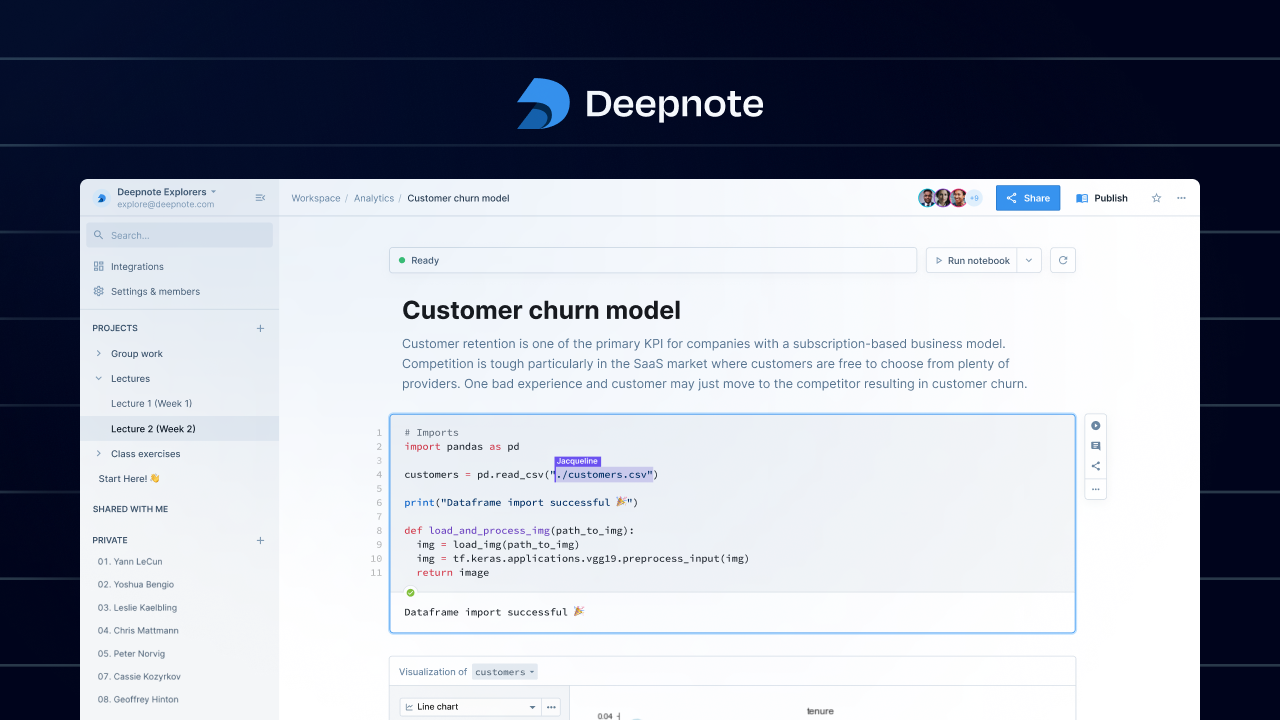
Deepnote is a cloud notebook platform where teams write Python and SQL in the same document with real-time collaboration, commenting and version history, and no local environment setup. Notebooks are executable artifacts: schedulable, API-triggerable and deployable as data apps. It keeps an open notebook format with a CLI and file sync, so work is portable rather than locked in, and viewers are free so only editors count toward the bill. Two practical points. The free plan caps at three editors and five projects, which small teams outgrow quickly, and premium warehouse connectors, scheduling and background execution sit on paid tiers running roughly $39 to $59 per editor monthly depending on billing. And Deepnote's own documentation and pricing page have carried inconsistent plan names, so confirm which tier includes the AI and scheduling features you actually need before subscribing.
Key Features
How to Use Deepnote
✅ Best For
- Data science teams and ML engineers who need a collaborative, cloud-based notebook environment with GPU access and ETL capabilities, without the overhead of managing local Jupyter setups.
- Academic researchers, students, and bootcamp graduates who want a free, fully managed Python and SQL environment with easy sharing and version control built in.
❌ Not For
- Business users who need a no-code, point-and-click dashboard builder without any exposure to Python or SQL code, as Deepnote's core workflow is notebook-based.
- Enterprise teams requiring an all-in-one BI platform with drag-and-drop report builders and business-user-friendly self-serve features out of the box.
Reviews
No reviews yet. Be the first to review Deepnote!
Pricing
- ✓1 workspace
- ✓5 projects
- ✓750 compute hours/month
- ✓Unlimited projects
- ✓advanced compute
- ✓SSO
- ✓Private deployment
- ✓HIPAA
- ✓audit logs
- ✓dedicated support
Prompts to Try
Write a Python script to merge two DataFrames and calculate monthly revenue by product
Run a SQL query on my BigQuery table and plot the result as a line chart
Clean this dataset by removing nulls and standardizing column names
Train a simple linear regression model on this sales data
Schedule this notebook to run every Monday at 9am and email me the output