Cohere is an enterprise AI company founded in 2019 by former Google Brain researchers, including a co-author of the original transformer paper. Its Command model family, alongside Rerank and Embed, targets retrieval-augmented generation, enterprise search and agentic workflows rather than consumer chat. North is its se…
Best for:Enterprises needing private or on-premise AI deploymentOrganizations in finance, healthcare, and government with strict data complianceDevelopers building multilingual AI applications
Not ideal for: Individual users looking for a simple chat interface
Phind was an AI search engine built specifically for software developers, pairing live web retrieval with model reasoning to answer technical questions grounded in current documentation rather than stale training data. It understood code context, cited its sources so you could verify an answer against the underlying do…
Best for:Software developers needing citation-backed technical answersDevOps engineers troubleshooting infrastructure issuesStudents learning programming with sourced explanations
Not ideal for: General chat or creative writing tasks
Elicit is a research assistant built by Ought for genuine academic work rather than general question answering. It searches a very large indexed corpus of papers, screens them against your criteria, and extracts structured data into tables, which is precisely the labour that makes systematic reviews slow. It supports P…
Best for:PhD students and academic researchers conducting systematic literature reviews who need auditable, reproducible workflows that satisfy journal and institutional standards.Clinical researchers and biotech teams running evidence synthesis at scale, needing to screen thousands of abstracts in hours rather than weeks.Policy analysts and consultants who must back recommendations with peer-reviewed evidence and need structured data extracted across dozens of studies.
Not ideal for: Users who need a writing assistant or manuscript editor alongside their research tool, as Elicit focuses entirely on literature discovery and extraction.
Semantic Scholar is a free academic search engine from the Allen Institute for AI, indexing more than 200 million papers across every discipline. Rather than keyword matching alone, it extracts meaning from full texts to surface influential citations, generate one-sentence TLDR summaries, and build personalised researc…
Best for:Graduate students and early-career researchers who need a free, powerful alternative to Google Scholar with smarter relevance ranking and AI-generated summaries.Developers and data scientists who want a free academic knowledge graph API to build research-adjacent tools and pipelines.Lab directors and faculty who want to monitor citations to their own papers and track how their work is being referenced across the field.
Not ideal for: Researchers who need paywall-bypassing full-text access or institutional licensing, as Semantic Scholar only links to Open Access content and does not provide journal subscriptions.
ResearchRabbit builds visual maps of connected literature from seed papers, showing citation networks and co-authorship links so you can follow how a field developed rather than guessing keywords. It syncs with Zotero, supports collaborative collections, and sends alerts when new papers relevant to a collection appear,…
Best for:PhD students and academic researchers who are mapping a new research field for the first time and need to understand the citation landscape before committing to a topic or direction.Research teams and labs who collaborate on shared literature collections and want a visual, non-keyword-based way to discover what they might be missing in their field.Librarians and faculty building reading lists who want to visually show students how foundational papers connect to contemporary research in an interactive map format.
Not ideal for: Researchers who need full-text PDF reading, annotation, or AI-powered explanation tools within the platform, as ResearchRabbit is focused purely on discovery and mapping rather than in-depth reading assistance.
Connected Papers builds an interactive graph of academic literature from a single seed paper. Its distinguishing method is similarity rather than direct citation: papers cluster by how much bibliographic ground they share, so the map surfaces closely related work that never cited your starting point and would be invisi…
Best for:Researchers entering a new field who want to quickly understand the citation landscape around a foundational paper without spending days on database searches.Applied scientists and R&D professionals who need to find relevant academic work outside their immediate specialty and want a visual, non-keyword approach to discovery.Literature review teams who want to visually demonstrate the evolution of a research field to collaborators or in academic presentations.
Not ideal for: Researchers who need a multi-seed discovery tool with unlimited graphs on the free tier, as Connected Papers limits free users to 5 graphs per month and builds graphs from a single seed at a time (multi-origin available on paid plans).
Zotero is a free, open-source reference manager from the non-profit Corporation for Digital Scholarship, and it remains the default recommendation for researchers who want their bibliography under their own control. A browser connector captures references from journal pages in one click, the built-in PDF reader support…
Best for:Students and academic researchers who want a completely free, full-featured reference manager with no usage limits, seamless word processor integration, and thousands of citation style options for any journal or institution.Labs and research groups that need to share a collaborative library with unlimited team members at no cost, annotate shared PDFs, and maintain a synchronized group bibliography.Power users and developers who want an open-source, extensible platform they can customize with a rich ecosystem of community-built plugins for AI chat, semantic search, and advanced bibliography management.
Not ideal for: Researchers who need built-in AI-powered literature discovery, semantic search across databases, or systematic review automation, as Zotero is a reference organizer and does not search academic databases natively for new papers.
AI research workspace for literature reviews that organized PDFs, auto-generated findings tables, and ran semantic search across documents. Sunset June 2025.
Lateral was an AI research workspace built in Berlin that unified PDF storage, semantic search and literature review into one tool. Its Super Search indexed your documents so you could find passages by concept rather than exact keyword, and auto-generated findings tables collected highlights across papers, which made i…
Best for:Academic researchers and PhD students who needed a fast, visual way to organize and cross-reference large collections of PDFs for systematic literature reviews without switching between multiple tools.Market research analysts and consultants who worked through large document sets and needed semantic search and auto-organized findings tables to synthesize evidence quickly for client reports.
Not ideal for: New users looking for an active, supported tool, since Lateral was sunset in June 2025 and is no longer available for new sign-ups or existing access.
Mendeley is a long-established reference manager offering PDF organisation and annotation, a Word citation plugin covering thousands of styles, browser-based reference capture and shared group libraries for collaborative projects. The free tier includes 2GB of storage, which covers a typical thesis-scale library, and t…
Best for:Researchers and students deeply embedded in the Elsevier publishing ecosystem who benefit from seamless one-click import from Scopus and ScienceDirect and want a clean, polished reference manager with strong Word integration.Academic teams and research groups who need shared collaborative libraries with permission controls for managing a joint bibliography on group projects, institutional reviews, or multi-author papers.Researchers transitioning from other reference managers who want a free, reliable tool with automatic metadata extraction, cross-device cloud sync, and a proven Word plugin for in-text citation management.
Not ideal for: Researchers who prioritize open-source software and data ownership, since Mendeley is owned by Elsevier, a major commercial publisher, and some academics have raised privacy concerns about how reading data and library habits may be used.
AI research agent that mimics human expert searching, iteratively reading hundreds of papers to find literature 10-50x more precisely than Google Scholar.
Undermind is a literature search agent built by former MIT physicists that works by iterative reasoning rather than a single query: it searches, reads, follows conceptual connections and ranks results, returning a structured report with explicit relevance scores and explanations of why each paper was retrieved. Its val…
Best for:Research scientists, physicians, and biotech professionals working on complex, high-stakes questions who need the most comprehensive and precise literature coverage available, not just the top keyword matches.PhD researchers and faculty who regularly conduct literature reviews and want an agent that finds papers they would otherwise miss, including niche studies that use different terminology from their query.Enterprise R&D teams at pharma, biotech, and deep-tech companies who need a reliable AI research layer that integrates with internal data sources and delivers proactive alerts on new findings.
Not ideal for: Researchers who need a fast, real-time conversational search experience or interactive chat with papers, since Undermind's search takes 8-10 minutes per query and delivers results via email rather than an instant browser interface.
Litmaps turns a set of seed papers into an interactive citation map showing how a field connects, then keeps working after the initial search: saved maps monitor the literature and alert you when relevant new papers appear, which is the difference between a one-off discovery tool and something that stays useful across …
Best for:PhD students and academic researchers mapping a new field who want a richer, more customizable visual alternative to Connected Papers, with map axis controls, multi-seed combination, and automatic monitoring alerts.Research teams at universities and institutions who need to collaborate on shared literature maps, export to Zotero, and keep their literature review automatically updated as new papers are published.Policy analysts and science librarians who need to visualize and communicate a field's research landscape to non-specialist stakeholders, using Litmaps' shareable, downloadable map figures.
Not ideal for: Researchers who need AI-generated written summaries, data extraction tables, or systematic review automation alongside their paper discovery, as Litmaps focuses exclusively on visual citation mapping and does not include document reading or synthesis tools.
Tableau is among the most established BI platforms, known for visualisation quality and the depth of what analysts can build. It connects to almost any source from spreadsheets to cloud warehouses, and its drag-and-drop authoring produces interactive dashboards without code. Salesforce has since layered agentic AI feat…
Best for:Enterprise analytics teams and BI professionals who need a scalable, governed platform for building and distributing trusted dashboards across hundreds of users.Sales and revenue operations teams using Salesforce data who want AI-generated performance summaries delivered to their inbox without logging into a BI tool.
Not ideal for: Small teams or individual analysts on tight budgets, as Tableau's per-seat pricing can become expensive quickly compared to lighter no-code alternatives.
Power BI is Microsoft's business intelligence suite, combining Power BI Desktop for authoring, the cloud service for sharing, and mobile apps, with connectors to hundreds of sources and a modelling layer built on DAX. Its advantage is ecosystem: for organisations already on Microsoft 365, integration with Excel, Teams,…
Best for:Organizations already using Microsoft 365 who want a BI tool that integrates natively with Excel, Teams, SharePoint, and Azure without adding another vendor relationship.Finance and accounting teams that need paginated, pixel-perfect reports and complex DAX models to handle multi-dimensional financial analysis.
Not ideal for: Teams that need best-in-class data visualization aesthetics or highly custom chart types, as Power BI's visuals can feel rigid compared to Tableau or Looker.
ThoughtSpot is built around search rather than dashboards: business users type a question in natural language and its Spotter AI agent returns an answer, a chart and follow-up analysis without waiting on a BI team. It also serves embedded analytics for software vendors, and its code-first data workspace came from the M…
Best for:Business analysts and department heads who want self-serve access to live warehouse data without writing SQL queries or submitting tickets to the data engineering team.Product teams building SaaS applications who need to embed white-labeled, AI-powered analytics directly inside their product to drive user engagement.
Not ideal for: Small businesses or startups that do not have a modern cloud data warehouse already in place, as ThoughtSpot requires Snowflake, BigQuery, or a similar platform to function properly.
Hex unifies data exploration and sharing in one workspace: analysts write SQL and Python in a notebook, a Notebook Agent writes, edits and debugs code alongside them, and the result publishes as a polished interactive app that business users can filter and explore without touching the underlying code. That last step is…
Best for:Data engineers and analysts who want to write SQL and Python in one environment and share polished, interactive reports with stakeholders without switching to a separate BI tool.Data teams at companies like Notion or Ramp that need a governed self-serve analytics layer so business users can ask their own questions against live warehouse data.
Not ideal for: Non-technical business users who have no data warehouse and need a simple drag-and-drop dashboard tool without any SQL or Python involvement.
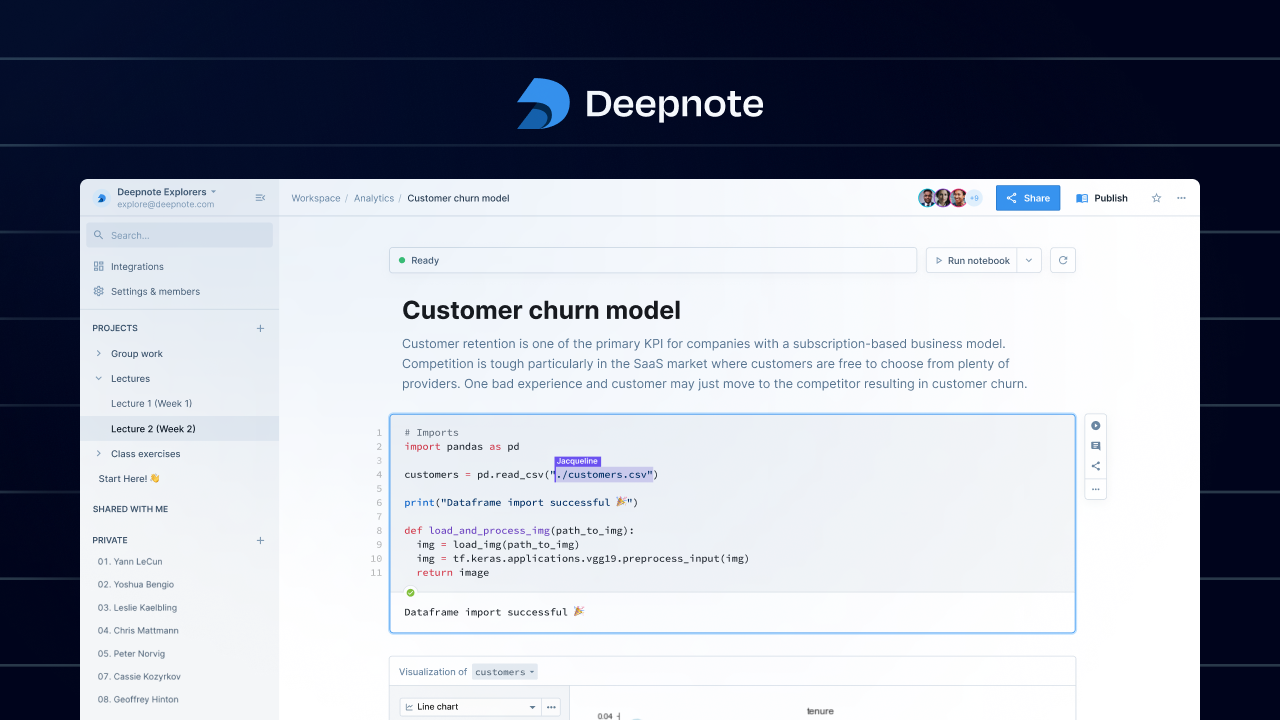
Deepnote is a cloud notebook platform where teams write Python and SQL in the same document with real-time collaboration, commenting and version history, and no local environment setup. Notebooks are executable artifacts: schedulable, API-triggerable and deployable as data apps. It keeps an open notebook format with a …
Best for:Data science teams and ML engineers who need a collaborative, cloud-based notebook environment with GPU access and ETL capabilities, without the overhead of managing local Jupyter setups.Academic researchers, students, and bootcamp graduates who want a free, fully managed Python and SQL environment with easy sharing and version control built in.
Not ideal for: Business users who need a no-code, point-and-click dashboard builder without any exposure to Python or SQL code, as Deepnote's core workflow is notebook-based.
DataRobot is an enterprise AI platform covering the full model lifecycle: automated machine learning that builds and compares many candidate models at once, deployment, monitoring, retraining and governance across both predictive and generative AI. It runs as single-tenant SaaS, in your own VPC or self-managed, integra…
Best for:Enterprise data science teams in financial services, healthcare, and manufacturing who need a governed, scalable AutoML platform to build and deploy accurate predictive models faster than coding from scratch.AI governance and compliance officers who need built-in model monitoring, drift detection, fairness auditing, and regulatory explainability reports bundled into a single enterprise platform.
Not ideal for: Small businesses or individual analysts looking for a lightweight, self-serve BI or dashboard tool, as DataRobot is an enterprise MLOps platform with pricing and complexity scaled to large organizations.
Enterprise analytics platform powered by a unique associative engine that lets users explore data freely in any direction without predefined query paths.
Qlik Sense is an enterprise analytics platform built on an associative engine, which is its genuine technical differentiator. Where query-based tools return only what matches your filter, Qlik shows both related and unrelated values on every selection, so users can see what is excluded as well as what is included. That…
Best for:Enterprise analytics teams and BI professionals who need to explore complex, multi-source datasets freely without predefined drill paths, and want an associative engine that surfaces hidden relationships other tools miss.Data-driven organizations in finance, retail, and manufacturing that require strong enterprise governance, row-level security, and the ability to embed interactive analytics into their own internal and external applications.
Not ideal for: Small teams or startups on tight budgets, as Qlik Sense is priced for enterprise buyers and the total cost including implementation and data engineering often exceeds $100,000 annually.
Google Cloud's enterprise BI platform with a powerful semantic layer (LookML), Gemini AI, and governed self-service analytics for data-mature organizations.
Looker is Google Cloud's enterprise BI platform, built around LookML, a semantic modelling layer where business metrics are defined once in code and reused across every dashboard, report and API call. That single-source-of-truth approach is what large organisations buy it for: it prevents the situation where three team…
Best for:Data-mature enterprises already on Google Cloud and BigQuery that need a governed semantic layer defining company metrics once, so every dashboard and report uses the same trusted definitions.SaaS companies building embedded, customer-facing analytics into their product who need a flexible, API-first BI platform that white-labels beautifully and scales to thousands of end users.
Not ideal for: Teams without SQL developers or data engineers who can build and maintain LookML models, as Looker requires significant technical investment before non-technical users can self-serve effectively.
Metabase is an open-source business intelligence tool built to make data accessible beyond the analytics team. Its visual query builder lets non-technical users filter, group and chart data without writing SQL, while analysts can drop into raw SQL when needed. It also ships an embedding SDK for putting analytics inside…
Best for:Startup and scale-up engineering teams who want a free, self-hosted BI tool that lets the whole company explore data without submitting requests to the data team, cutting analytics lead times from days to minutes.SaaS developers building customer-facing analytics into their application who need an affordable, open-source embedded analytics option with a straightforward SDK and active community support.
Not ideal for: Large enterprises requiring heavy-duty data governance, enterprise SSO, fine-grained role hierarchies, and advanced security controls, as these features are limited in the free open-source tier.
SQL-first analytics platform combining a collaborative query editor, Python and R notebooks, and interactive dashboards in one workspace for data teams.
Mode is an analytics platform built for analysts who want to write SQL, run Python or R notebooks and publish dashboards without switching tools. Its shared SQL editor keeps every query saved and organised so teams build on each other's work rather than rewriting it, and its notebook layer supports advanced analysis be…
Best for:Data analysts and analytics engineers who want to write SQL and run Python or R notebooks in one place and share polished, interactive reports with business stakeholders without switching between multiple tools.Analytics teams at mid-size SaaS and technology companies that need a centralized platform for both ad-hoc analysis and recurring stakeholder reporting, replacing a fragmented stack of SQL editors, notebooks, and dashboarding tools.
Not ideal for: Non-technical business users who need a no-code, drag-and-drop analytics experience, as Mode's core workflow is SQL-first and assumes familiarity with writing queries.
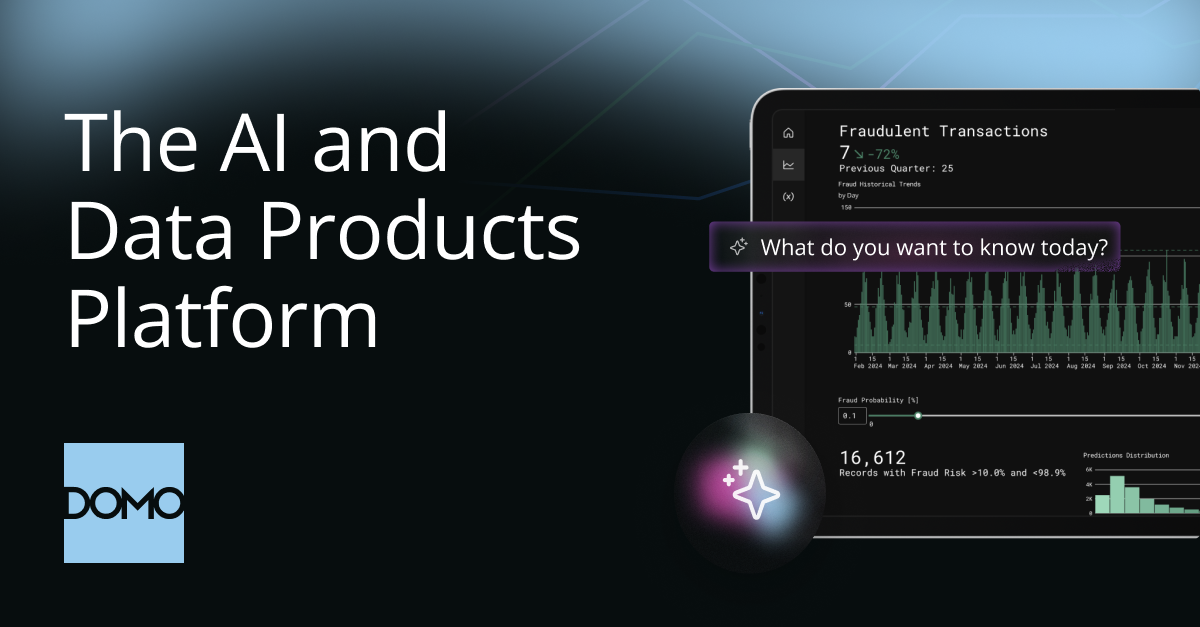
Domo is a cloud-native business intelligence platform that handles the whole stack in one place: data integration from over a thousand connectors, ETL through its Magic ETL builder, dashboarding, self-service reporting, low-code apps, embedded analytics and an AI agent layer. For organisations that want ingestion, tran…
Best for:Enterprise operations, finance, and sales teams that need a single platform to connect hundreds of data sources, build executive dashboards, and deploy AI agents without managing a fragmented multi-tool analytics stack.Retail, healthcare, and financial services organizations that require real-time operational analytics, mobile-friendly dashboards for field teams, and low-code data app building on a unified governed platform.
Not ideal for: Data scientists and ML engineers who need deep Python notebook integration, custom model training infrastructure, or a code-first analytical environment beyond Domo's built-in data science capabilities.
AI-powered analytics platform for building, embedding, and composing data experiences into any application with generative AI and a flexible cloud architecture.
Sisense is an analytics platform built primarily for embedding rather than internal dashboards. Its Compose SDK offers a code-first, composable approach so product teams can build data experiences into their own applications rather than iframing someone else's dashboard, and it adds a generative AI assistant, an MCP se…
Best for:SaaS companies and ISVs building analytics-as-a-feature inside their own product who need a flexible, API-first embedded analytics platform that handles multi-tenancy, white-labeling, and AI-generated insights out of the box.Enterprise teams in financial services, healthcare, and supply chain that need a composable, AI-powered analytics platform integrating with their existing application stack via the MCP server and Compose SDK.
Not ideal for: Teams primarily looking for a self-serve BI tool for internal reporting and exploration, as Sisense is optimized for embedded analytics in product rather than standalone internal dashboards.
Sigma Computing gives business users a spreadsheet-like interface over live cloud warehouse data. Rather than extracting data into a proprietary engine, queries push down to Snowflake, Databricks, BigQuery or Redshift, so analysis runs against current data at warehouse scale without SQL. For finance and operations team…
Best for:Analytics teams and business users at data-mature companies running Snowflake, BigQuery, or Databricks who are comfortable with spreadsheets but not SQL, and want to self-serve warehouse-scale analysis without depending on a data engineer.Finance, revenue operations, and product teams that need to write back data, model scenarios, and build governed AI applications on live warehouse data in a single, collaborative workspace.
Not ideal for: Organizations that do not have a cloud data warehouse, as Sigma requires Snowflake, BigQuery, Databricks, or Redshift as its data foundation and cannot connect to flat files or local databases as a standalone source.
Voiceflow is an agent-building platform for product, design and engineering teams that need more than a website chatbot: the same agent can run across chat, voice and phone, with call forwarding and keypad input handled natively. It gives collaborative design tooling, API integrations and access to frontier models, pos…
Best for:Product and design teams at mid-market companies who want to build sophisticated AI agents without waiting on engineering sprints.Conversational AI agencies managing multiple client deployments who need white-labeling, workspace separation, and transparent per-client billing.
Not ideal for: Solo founders who just want a simple FAQ bot deployed in 15 minutes as Voiceflow's power comes with more setup complexity.
Botpress is a developer-oriented conversational AI platform combining a visual flow builder with genuine code control, so teams can prototype visually and then drop into custom logic rather than hitting a no-code ceiling. It covers a wide range of deployment channels, supports over a hundred languages, and is used by e…
Best for:Development teams and technical founders who need deep customization, self-hosting options, and code-level control over their AI agent's behavior.Enterprises building multi-bot ecosystems across product lines who need RBAC, audit trails, and enterprise-grade infrastructure.
Not ideal for: Non-technical users or marketers expecting a simple drag-and-drop setup without any code as Botpress's power requires developer involvement for advanced use cases.
CustomGPT.ai builds AI agents trained exclusively on your own business content, so answers stay inside your documentation rather than drawing on general model knowledge. Its emphasis is accuracy and traceability: responses cite their sources, and the retrieval design is aimed at reducing the invented answers that make …
Best for:Enterprise teams in regulated industries like government, healthcare, and education who need an AI agent that cites its sources accurately and never fabricates information.Mid-market SaaS companies that want to deploy a website search and support chatbot that draws only from their official documentation and support content without hallucinating answers.
Not ideal for: Teams looking for a social media automation or marketing chatbot as CustomGPT.ai is purpose-built for knowledge-based Q&A rather than campaign flows or DM automation.
SiteGPT builds a customer support chatbot from your own website content: point it at a URL or upload documents, and it produces an agent that answers in your product's context, escalates to a human when needed, captures leads and works across many languages. It uses retrieval-based architecture so answers stay grounded…
Best for:SaaS companies and online businesses that want a support chatbot that knows every page of their documentation and can answer visitor questions accurately without any manual Q&A scripting.Startups and solo founders who want a production-ready AI support agent up and running in under 30 minutes trained specifically on their product, pricing, and policies.
Not ideal for: E-commerce brands that need deep Shopify or WooCommerce integrations with order tracking, cart recovery, and transactional message flows as SiteGPT is focused on knowledge-based Q&A rather than commerce automation.
Intercom is a comprehensive customer support platform pairing a full-featured helpdesk with Fin, its natively integrated AI agent, plus proactive messaging and a help centre. Fin is among the most production-proven agents available, widely reported to resolve half or more of inbound tickets for teams with a solid knowl…
Best for:Mid-market and enterprise SaaS companies that want a single platform for AI automation, human support, and proactive customer engagement without stitching together multiple tools.Fast-growing startups in Intercom's Early Stage program that get 90% off in year one and want to build their support infrastructure on an enterprise-grade platform from day one.
Not ideal for: Small businesses or solopreneurs with low support volume as Intercom's per-seat and per-resolution pricing model becomes expensive quickly and the platform's complexity often exceeds what small teams need.
Typebot is an open-source builder for conversational forms and chatbots, widely used as a self-hosted alternative to Landbot. Its 45-plus blocks let you assemble lead qualification, onboarding and support flows visually, embed them on websites, in React apps or on WhatsApp, and collect results in real time. Reviewers c…
Best for:Developers and technical founders who want an open-source chatbot builder they can self-host on their own infrastructure for full data sovereignty without vendor lock-in.Freelancers and agencies building conversational forms, lead capture bots, or onboarding flows for multiple clients who need a cost-effective, white-label-ready solution.
Not ideal for: Teams that need a native live chat inbox with human agent handoff and ticketing as Typebot is a bot-building platform and does not include a built-in helpdesk or shared inbox.
DocsBot AI converts existing documentation into interactive chatbots, ingesting PDFs, help articles, web pages, Notion, Zendesk and YouTube content through a retrieval pipeline so answers stay grounded in your material. Its appeal is the breadth of sources: teams whose knowledge is scattered across several systems can …
Best for:Documentation-heavy SaaS companies and developer tool businesses that want an AI bot capable of answering precise technical questions with citations from their official docs, reducing support engineer workload.Internal teams at mid-market companies looking to replace the endless Slack question-and-answer cycle by giving employees instant access to company knowledge, policies, and SOPs via a conversational AI layer.
Not ideal for: Businesses looking for social media or WhatsApp chatbot automation as DocsBot is purpose-built for knowledge-based Q&A across web and API channels rather than social messaging platforms.
YourGPT builds AI agents for customer support and sales, deployable across WhatsApp, Instagram, Messenger, Slack and Telegram from one workspace, with support for several underlying models and multi-step workflow automation. Its positioning is flat-rate: plans include seats rather than metering per user or per resoluti…
Best for:Growing businesses and mid-market companies that want a single AI platform covering customer support, sales automation, and internal workflow automation without subscribing to multiple tools.Teams operating across multiple messaging channels including WhatsApp, Instagram DMs, Telegram, and Discord who need one AI agent that maintains a consistent persona and knowledge base across all channels.
Not ideal for: Solo founders or micro-businesses who just need a simple FAQ bot on their website as YourGPT's multi-module architecture adds complexity that may be overkill for very basic use cases.
Tars is an enterprise no-code conversational AI platform focused on a specific problem: replacing static forms with guided conversations for lead generation, onboarding and support in regulated industries. It offers a large template library, extensive integrations, and HIPAA and SOC 2 compliance, which is why healthcar…
Best for:Mid-market and enterprise teams in regulated industries including healthcare, finance, and government that need a no-code AI agent platform with proven compliance credentials and a large library of pre-built industry templates.Global businesses operating across multiple languages and regions who need a chatbot platform with 100+ language support, multi-channel deployment, and 600+ integration options without requiring a developer on staff.
Not ideal for: Early-stage startups and bootstrapped founders who need an affordable entry-level chatbot as Tars is priced for enterprise budgets starting at $500+/month and may not offer the ROI for businesses with low conversation volumes.
Freshchat is Freshworks' customer messaging platform, combining live chat, AI bots powered by Freddy and omnichannel conversations across web, WhatsApp, Instagram and SMS in a single shared inbox. It fits teams that want one place for every customer conversation rather than separate tools per channel, and it connects n…
Best for:Growing digital businesses and e-commerce brands already using Freshworks tools like Freshdesk or Freshsales who want a tightly integrated messaging and AI support layer without adding a new vendor.Customer support teams that need a unified inbox managing web chat, WhatsApp, Instagram, email, and SMS in one place with AI-powered routing, copilot assistance, and SLA tracking built in.
Not ideal for: Teams looking for a standalone AI bot builder with deep customisation options, open-source flexibility, or multi-LLM support as Freshchat's Freddy AI runs on Freshworks' own models and does not support custom LLM integrations.
Revdoku publishes AI agent-generated reports, dashboards, and prototypes as live websites with a stable URL, connecting via CLI, API, MCP, or web upload from Claude, ChatGPT, Codex, and other agent workflows.
Revdoku is the sharing layer for work your AI agents generate. Instead of setting up hosting for every report, dashboard, prototype or mini-site that Claude, ChatGPT, Gemini, Grok or Codex produces, you publish straight from a CLI, a REST API, an MCP server or a web upload and get a stable revdoku.site URL. Re-publishi…
Best for:AI agent builders and vibe coders who want a one command way to turn a Claude, ChatGPT, or Codex output into a real, shareable websiteDevelopers and consultants who need to publish client demos, prototypes, or reports without setting up their own hosting pipelineProduct teams that regenerate the same dashboard or report repeatedly and need the share link to stay constant across updates
Not ideal for: Teams needing custom backend server code inside a published page, since Revdoku is built for static and front end style outputs
Ajelix is a full agentic AI workspace trusted by 340,000+ professionals that goes far beyond a chatbot. Upload files up to 1GB, and Ajelix builds working Excel files with formulas, interactive dashboards, PowerPoint presentations, VBA scripts, web apps, and more. Assets persist across every conversation in a shared lib…
Best for:Finance, operations, and marketing professionals who need to turn raw data into polished, presentation-ready reports, dashboards, or Excel models weekly, and want an AI that actually completes the project rather than just suggesting how to do it.
Not ideal for: Users who only need basic formula help or a lightweight formula generator, rather than a full AI workspace that builds, saves, and manages complete work deliverables.
Quadratic is a next-generation AI spreadsheet trusted by 250,000+ people at Bloomberg, MIT, Apple, and BCG. It combines the familiar grid of Excel with the full power of Python, SQL, JavaScript, and formulas, all written by AI on your behalf. Connect live databases like Postgres, Snowflake, and BigQuery, ask questions …
Best for:Data analysts, product managers, and finance teams who work with live databases and need to produce shareable, auditable analysis without writing Python or SQL themselves, while still being able to see and verify the code the AI generates.
Not ideal for: Business users who want a completely no-code experience and are not comfortable seeing or managing any code cells, as Quadratic's core value is transparent, editable AI-generated code rather than black-box outputs.
Coefficient is a no-code data platform trusted by 700,000+ teams at Netflix, Anthropic, Cursor, Miro, and Uber. It connects Google Sheets and Excel to 150+ live data sources including Salesforce, HubSpot, Snowflake, QuickBooks, and more. AI agents sync data, clean it, build BI-quality dashboards, and send Slack or emai…
Best for:Revenue operations, finance, and marketing teams at growing companies who need live business data from tools like Salesforce, HubSpot, and Snowflake to flow directly into Google Sheets or Excel for reporting, without waiting on a data engineer to build a pipeline.
Not ideal for: Individual users or very small teams who only need basic formula help and do not have live business data sources to connect, as Coefficient's core value is its integration depth and automated sync rather than standalone AI analysis.
Sourcetable is an AI-native spreadsheet described by Forbes as 'the spreadsheet for the next billion users, both human and AI.' It fuses Excel-style formula referencing with full Python, SQL, NumPy, Pandas, and Plotly support, all generated by AI on your behalf. Connect to Postgres, Stripe, Robinhood, Notion, GA4, Face…
Best for:Financial analysts, data scientists, and startup founders who need to run sophisticated analysis including Python-powered models, SQL queries, and statistical tests without switching between tools or writing code themselves.
Not ideal for: Teams who primarily want to connect live CRM or marketing platforms to a spreadsheet for automated reporting, rather than a code-capable AI data science environment for ad hoc analysis and modeling.
GPT for Work is an ISO 27001-certified AI agent built by Talarian, a profitable Swiss software company, with 7 million installations and a 4.8-star rating on the Google Workspace Marketplace. It writes formulas, fixes errors, formats cells, builds pivot tables, creates charts, and processes up to 1 million rows in bulk…
Best for:Operations, e-commerce, SEO, and sales teams at mid-to-large companies who need to run AI on thousands of rows at once, from bulk content generation and lead enrichment to data cleaning and translation, without paying per seat or switching between tools.
Not ideal for: Individual users who only need occasional formula help and don't require bulk row-by-row AI processing at scale, as GPT for Work's core strength and pricing model are built around high-volume team workflows.
Powerdrill Bloom is an AI-native data analysis workspace where a team of specialized AI agents processes your data, documents, and open datasets and builds institutional memory across every analysis. Unlike one-shot AI tools, Powerdrill agents learn from your past sessions, so repeat analyses get faster and more accura…
Best for:Financial analysts, market researchers, and data scientists who work with complex, recurring analyses and need an AI workspace that builds on previous sessions rather than starting from scratch each time, with access to financial, healthcare, and macroeconomic open data built in.
Not ideal for: Business users who need to automate spreadsheet formulas or build simple dashboards from internal CRM or sales data, as Powerdrill's core value is deep research and iterative analysis against structured open datasets rather than everyday spreadsheet task automation.
Enterprise AI analytics platform that detects metric shifts early, explains every change with full data lineage, and embeds decision-ready insights in your existing tools.
Arcwise is an enterprise-grade AI analytics platform designed for data-intensive industries including logistics, airlines, insurance, and operations. It connects to data warehouses like Snowflake, BigQuery, and Databricks, learns your business context from documentation and operating logic, and automatically surfaces m…
Best for:Data and operations leaders at mid-to-large enterprises in logistics, airlines, insurance, and finance who need to catch meaningful metric shifts before executive reviews and get AI-written, fully auditable explanations their teams can act on immediately.
Not ideal for: Small businesses or individual analysts who need a self-serve spreadsheet or lightweight BI tool, as Arcwise is built for enterprise data warehouse environments and requires a sales-led onboarding process.
The spreadsheet engine for AI agents and developers that gives LLMs a structured interface to read, write, and calculate spreadsheets without generating brittle code.
GRID is a developer-focused spreadsheet engine built for AI-native products. Install from npm, give your AI agent structured tool calls to read cells, apply changes, and recalculate, and GRID handles the deterministic Excel-compatible math without the agent generating fragile Python code each time. It includes a Spread…
Best for:AI engineers, product developers, and solution architects building agentic products that need to read, modify, or generate spreadsheets reliably, without the latency, token cost, and hallucination risk of having an LLM generate Python code to manipulate Excel files.
Not ideal for: Non-technical business users who want a no-code AI spreadsheet assistant, as GRID is a developer SDK and headless engine rather than a consumer-facing spreadsheet application.
AI-powered spreadsheet copilot that cleans, transforms, and analyzes large datasets 10x faster using natural language commands instead of formulas or scripts.
Luminal is an AI data copilot designed for data analysts and teams working with large, messy spreadsheets. Upload a file and describe the transformation, cleaning, or analysis you need in plain English. Luminal uses AI to write Python behind the scenes, process millions of rows at high speed, answer complex questions e…
Best for:Data analysts, operations managers, and finance professionals who regularly work with large, inconsistent datasets and need to clean, transform, or extract insights from them quickly, without writing Python scripts or spending hours on manual Excel work.
Not ideal for: Users who need a full dashboard or BI platform to share live data with stakeholders, rather than a powerful single-session AI copilot for cleaning and analyzing one dataset at a time.
Agentic AI data analyst that analyzes large spreadsheets and databases with SQL and Python, delivers shareable dashboards, and schedules recurring reports automatically.
Anomaly AI (findanomaly.ai) is a no-code AI data analyst designed for teams working with large datasets, Excel files, CSVs, Google Sheets, and SQL databases. Ask questions in plain English and get answers backed by transparent, reviewable SQL queries and full data lineage. Build shareable dashboards, automate recurring…
Best for:Data analysts, product managers, and operations leads at growth-stage companies who need to analyze large datasets and produce shareable dashboards without writing SQL, while still being able to see and verify the exact queries the AI used to reach its conclusions.
Not ideal for: Users who only need help with Excel formulas or basic spreadsheet formatting, rather than a deeper AI analysis tool designed for large-scale data exploration, SQL database queries, and recurring dashboard automation.
n8n is a source-available workflow automation and AI agent platform you can run entirely on your own infrastructure at no licensing cost, or use as a managed cloud service. It combines a visual node canvas with the ability to drop into JavaScript or Python wherever the nodes fall short, and its native AI agent nodes ma…
Best for:Developers and technical operators who want unlimited executions at near-zero cost by self-hosting on a small VPSCompanies with data residency, GDPR or compliance constraints that rule out sending workflow data through a third-party cloudTeams building AI agents and RAG pipelines who need vector stores, memory and multiple model providers inside the same workflow canvas
Not ideal for: Non-technical users who want a point-and-click experience, since expressions, JSON handling and node debugging assume real technical comfort
Activepieces is an MIT-licensed open-source automation platform positioned as the self-hostable alternative to Zapier and Make. It combines a visual no-code builder with more than 700 integrations, AI agents, MCP support and tables, and the Community Edition can be self-hosted at no licence cost, which is the main reas…
Best for:Teams migrating off task-based platforms whose bills climbed unpredictably, since per-flow pricing makes costs flat and forecastable regardless of run volumeEngineering-comfortable organisations that need data to stay on their own infrastructure for compliance, residency or security reasonsStartups embedding automation inside their own product, because the MIT licence and embedded offering permit commercial white-labelling without restriction
Not ideal for: Teams needing the longest tail of niche SaaS connectors, since 700+ pieces is far short of Zapier's 9,000+
Gumloop is an AI-native workflow platform where model calls are the point rather than a bolt-on. You build flows on a node canvas, dragging in scrapers, LLM steps, document parsers and app connectors, which makes it strong for research pipelines, lead enrichment and document processing that conventional automation tool…
Best for:Research and operations teams processing large volumes of unstructured input such as PDFs, contracts, transcripts or scraped web pages into clean structured dataGrowth and GTM teams running bulk enrichment or qualification pipelines across hundreds of companies at onceTechnically comfortable users who want visual control over an LLM pipeline without writing and maintaining Python scripts
Not ideal for: Teams whose core need is app-to-app syncing, since the integration library is much smaller than Zapier's or Make's
Pipedream is a code-friendly integration platform built for engineers who find no-code builders limiting. Every workflow is a sequence of steps, and any step can be a prebuilt component or arbitrary code in Node.js, Python, Go or Bash, with access to more than 10,000 APIs and full npm and PyPI package support. Connect …
Best for:Backend and full-stack developers who want the speed of managed OAuth with the freedom to drop into real code whenever a connector falls shortTeams whose workflows involve heavy custom logic, API orchestration or data transformation that visual builders express awkwardlySaaS companies using Pipedream Connect to embed a native integration marketplace inside their own product without building auth for every provider
Not ideal for: Non-technical users, because writing and debugging code steps is central to getting real value from the platform
Workato is an enterprise integration and automation platform aimed at organisations where automation crosses departments, touches systems of record and has to satisfy security review. It combines a large connector library with recipe-based workflow building, embedded API management, and agentic orchestration for AI-dri…
Best for:Mid-market and enterprise IT teams integrating systems of record such as SAP, NetSuite, Oracle, Salesforce and Workday across multiple business unitsOrganisations that need governance built into automation, including audit logs, role-based access, environment separation and change managementCompanies exposing internal processes as governed APIs, since Workato lets you publish recipes as managed endpoints with policies and rate limits
Not ideal for: Small businesses and solo operators, since contracts typically start around five figures annually and require a sales conversation
Power Automate is Microsoft's workflow automation and robotic process automation platform, and its biggest advantage is that most organisations already own part of it. Basic cloud flows are included with many Microsoft 365 licences, so teams inside the Microsoft ecosystem can automate SharePoint, Outlook, Teams and Dat…
Best for:IT and operations teams inside Microsoft-centric organisations, where SharePoint, Teams, Outlook and Dataverse are already the systems of recordEnterprises that need to automate legacy Windows desktop applications with no API, which browser-based and API-first tools simply cannot reachCompanies wanting approval workflows embedded natively in Teams and Outlook rather than bolted on through a third-party tool
Not ideal for: Small teams outside the Microsoft ecosystem, since much of the value comes from bundled M365 entitlements you would not otherwise be paying for
Tray.ai, formerly Tray.io, is an enterprise integration and automation platform aimed at revenue operations, marketing operations and IT teams building sophisticated multi-step workflows across systems of record. It combines a visual builder with genuine developer extensibility, an embedded integration offering for sof…
Best for:Revenue operations teams orchestrating lead routing, scoring and enrichment across CRM, marketing automation and a data warehouseMarketing operations specialists whose campaign logic involves conditional paths and transformations that simpler platforms handle clumsilyEnterprise IT teams integrating dozens of SaaS applications with real business logic rather than straightforward field mapping
Not ideal for: Small businesses and individuals, since there is no free tier, no self-service signup and entry contracts start in the four to five figure annual range
UiPath is the largest dedicated robotic process automation vendor and the platform most associated with enterprise automation centres of excellence. Its core strength is driving software that offers no API at all: mainframes, desktop applications and legacy ERP systems, where a robot operates the interface exactly as a…
Best for:Large enterprises with a dedicated automation centre of excellence, where a programme rather than a single workflow is being fundedOrganisations automating legacy Windows applications, mainframe terminals, Citrix sessions and desktop ERPs that offer no API at allRegulated industries such as banking, insurance and healthcare that need audit trails, governance and on-premise deployment options
Not ideal for: Small businesses and individual users beyond the free Community Edition, since production licensing moves quickly into five and six figures annually
Automation Anywhere builds Automation 360, a cloud-native platform that has repositioned from classic robotic process automation toward what the company calls agentic process automation, where AI agents handle decisions that rule-based bots could not. It covers attended and unattended bots, document processing for unst…
Best for:Cloud-first enterprises that want RPA infrastructure they do not have to host, deploy or patch themselvesFinancial services, insurance and BPO organisations processing high volumes of semi-structured documents such as claims, invoices and applicationsTeams adopting agentic automation who want AI agents making judgement calls inside governed, auditable processes
Not ideal for: Small businesses beyond the Community Edition, since commercial entry starts around $750 monthly and enterprise contracts commonly run six figures
Mastra is an Apache 2.0 licensed TypeScript framework for building AI agents and agentic workflows, created by the team behind Gatsby. It provides the pieces engineers otherwise assemble themselves: agent primitives, persistent memory, retrieval-augmented generation, workflow orchestration, evaluation harnesses and MCP…
Best for:TypeScript engineering teams shipping AI agents inside an existing Next.js, React or Node application rather than adopting a separate no-code platformDevelopers who want agents, memory, RAG, workflows and evals from one coherent framework instead of assembling four libraries that were never designed togetherTeams that need agent output quality measured, since built-in model-graded, rule-based and statistical evals let you track regression over time
Not ideal for: Non-technical users entirely, since Mastra is a code framework with no visual builder for the core workflow authoring experience
Scenario is a generative AI engine built for game studios and creative teams that need visual assets matching their existing art direction. Rather than relying on a single general model, you train custom models on your own artwork, so generated icons, props, characters and environments come out on-style rather than loo…
Best for:Mobile and live ops game studios that ship hundreds of on-brand assets a month and cannot afford visual drift between artistsArt directors who need every generated character, prop and UI element to sit inside an already approved visual style guideConcept artists who want to explore fifty silhouettes in an afternoon before committing a week to a single hero design
Not ideal for: Teams that need finished, production clean 3D topology, because generated meshes still require manual retopology before rigging
Inworld AI is a developer platform for building characters that think and speak in real time rather than reading from a dialogue tree. Writers define personality, backstory, goals and knowledge, and the runtime handles conversation, memory across sessions and voice, with SDKs for Unity and Unreal. Its text-to-speech ra…
Best for:Narrative studios building RPGs, life sims and adventure games where talking to characters is the core loop rather than a side activityWriters hitting the ceiling of branching dialogue trees, where every new variable doubles the authoring workloadUnity and Unreal teams that want a runtime SDK rather than a text generator they have to plumb in themselves
Not ideal for: Teams shipping games where NPCs are purely functional vendors or enemies, since scripted dialogue stays far cheaper
Meshy is a 3D generative platform that converts a text prompt or a handful of reference photos into a PBR-textured mesh in seconds, aimed at anyone needing 3D assets faster than modelling allows: indie developers, prototypers and artists building blockouts before committing to production geometry.
The credit maths dec…
Best for:Indie game developers who need dozens of background props and set dressing assets without hiring a 3D artistConcept artists who want to see an idea in three dimensions in a minute rather than blocking it out for an hourPrototyping teams that need placeholder assets good enough to test scale, framing and gameplay feel immediately
Not ideal for: Hero character work that needs clean, animation ready topology, because generated meshes typically require manual retopology
Rosebud AI is the reference prompt-to-playable tool: you describe a game in a browser editor and get a running web game in minutes, with no engine install and no C# required. It generates code, art and mechanics together, then lets you iterate conversationally, which makes it genuinely useful for game jams, teaching, p…
Best for:Complete beginners who want to see a working game today rather than finish a 40 hour engine tutorial firstEducators teaching game design or coding who need students building playable projects inside a single class periodGame jam participants racing a 48 hour deadline where speed from idea to playable matters more than polish
Not ideal for: Developers building large, complex commercial titles, as the code ceiling and browser runtime limit real project scale
Unity AI is the successor to Unity Muse, which the company has deprecated, and it lives directly inside the Unity 6 editor rather than in a browser. It ships as an assistant that answers project-specific questions and can act on your scene, plus generators for sprites, textures and animations, with MCP support so exter…
Best for:Unity teams that want AI acting on the actual project hierarchy rather than pasting code back and forth from a chat windowSolo developers who need placeholder sprites and textures generated without leaving the editor mid taskStudios already paying for Unity Pro or Enterprise, where AI credits and MCP access are bundled into the existing seat
Not ideal for: Godot, Unreal or custom engine teams, since the entire suite only runs inside the Unity editor
Unreal Engine powers a large share of AAA and high-end indie production, and by version 5.7 its machine learning tooling has moved from experimental to genuinely usable: an in-editor AI assistant, MetaHuman for digital characters, ML Deformer for high-quality deformation at runtime, and PCG for procedural world generat…
Best for:AAA and high end indie studios chasing photorealistic visuals where Nanite, Lumen and MetaHuman genuinely change what is achievableCharacter and animation teams that need film quality muscle, cloth and facial deformation running at real time frame ratesOpen world teams using procedural generation to populate landscapes that would take a decade to hand place
Not ideal for: Beginners looking for a prompt to playable experience, because Unreal expects real engine and programming knowledge
Promethean AI takes a deliberately different position from generative asset tools: it does not generate new art, it reasons about the art you already own. The system builds a semantic understanding of your asset library, then set dresses environments from natural language, so an artist can say what a room should feel l…
Best for:Environment artists who spend most of their week on set dressing rather than the creative decisions they were hired forStudios sitting on large existing asset libraries that are underused because nobody remembers what is in themArt directors who need outsourcing partners to hit the intended look without a fifty page style document
Not ideal for: Solo developers with no asset library, because the system reasons about assets you already own rather than generating new ones
Charisma.ai is an interactive storytelling platform built around a tension most conversational AI tools ignore: writers want characters that improvise, but they also need guarantees that the plot reaches its beats. Its answer is a visual story graph where authors define nodes, branches and outcomes, with generative dia…
Best for:Narrative designers and writers who want to build talking characters without waiting on an engineering sprintLearning and development teams building roleplay training where a live actor would otherwise be the only optionBrand and marketing agencies producing interactive campaign experiences that visitors talk to rather than click through
Not ideal for: Developers who want a full game engine, since Charisma handles conversation and narrative rather than gameplay systems
Layer is a generative AI platform built specifically for game studios rather than general creative work, and it has grown from a 2D concept tool into a creative engine covering concept art, icons, textures and production assets. Its central feature is custom model training: you train on your studio's existing artwork s…
Best for:Game studios that want one platform covering 2D, 3D, video and audio instead of paying for four separate subscriptionsArt teams where every contributor needs full tool access, since removing seat fees means nobody is locked out by budgetLive service studios producing constant seasonal content that must stay visually consistent with the base game
Not ideal for: Solo hobbyists who only need occasional images, where a simpler consumer image generator is cheaper and faster to learn
Summer Engine is a desktop game engine with an AI agent wired into the engine loop, and the distinction that matters is what it can do that a chat window cannot: it creates nodes, writes and attaches scripts, launches the game, observes what happens and reads the errors back. That closes the loop between generating cod…
Best for:Godot developers who want an agent that can actually run the game and read the debugger, not just hand back code snippetsSolo indies who need scene work, scripting, asset generation and debugging coordinated in one placeDevelopers who want AI speed but refuse to give up ownership, since output is a standard Godot project with no revenue share
Not ideal for: Unity and Unreal teams, since compatibility is with Godot 4 rather than those engines
Tripo AI is a 3D generation platform whose reputation rests on geometry quality: it produces meshes with cleaner topology than most competitors, which is the difference between an asset you can rig and animate directly and one an artist has to retopologise before it is usable. It generates from text prompts, images and…
Best for:Game developers who care about topology quality and want meshes closer to riggable out of the box3D artists who need a deep post generation toolkit rather than just a mesh dump they then rebuild elsewhereStudios prototyping at volume where an eight second first pass changes how many ideas get explored
Not ideal for: Anyone needing commercial rights on the free plan, since free tier models do not support commercial use
Godot Engine is a completely free and open-source game engine under the MIT licence, with no royalties, no subscription and no revenue share at any scale. It handles 2D and 3D, uses its own GDScript alongside C# and C++ bindings, and ships as a small self-contained editor. Its 2D pipeline is widely considered the best …
Best for:Indie developers and small studios who want a capable engine with genuinely zero cost and zero revenue share at any scaleDevelopers who value a lightweight editor and a node architecture that is quicker to reason about than heavier engines2D game teams, where Godot's dedicated 2D renderer is a real advantage over engines that treat 2D as a 3D special case
Not ideal for: AAA teams chasing photorealistic rendering at the level Unreal delivers out of the box
modl.ai works in a part of game development that gets far less attention than asset generation but consumes a large share of a studio's schedule: quality assurance. Rather than generating content, it trains bots that actually play your build, exploring levels, finding crashes and progression blockers, and surfacing bal…
Best for:Studios where manual regression testing eats days of every milestone and still misses build breaking crashesLive service teams shipping frequent patches that need automated coverage on every build without growing the QA headcountDesign teams tuning difficulty who need a controlled way to test how players at different skill levels experience a level
Not ideal for: Teams looking for asset, art or dialogue generation, since modl.ai does no content creation at all
Convai builds conversational AI characters that do more than talk. Its defining feature is multimodal perception: characters can see and hear their environment, recognise objects and other characters, and respond with actions as well as dialogue, so an NPC can notice you are carrying something and comment on it, or wal…
Best for:Developers who need NPCs that perceive the scene around them, not just characters that respond to typed textUnreal MetaHuman users who want real time lip sync and facial animation driven directly from generated speechNarrative designers without engineering support, since character creation happens entirely in a no-code browser tool
Not ideal for: Teams needing offline characters, because perception, reasoning and voice run as cloud services
Kinetix converts video into 3D character animation using single-camera markerless motion capture, so a phone clip becomes a usable avatar animation without a mocap suit, a volume or a studio booking. Its SDK extends that to players themselves, letting them generate custom emotes inside a game from their own footage, wi…
Best for:Avatar based games and virtual worlds that want players creating their own emotes rather than only buying studio made onesStudios needing animation retargeted across many different avatar systems without rebuilding the rig each timeMultiplayer titles where many custom animations play at once and bandwidth per animation genuinely matters
Not ideal for: Teams needing frame perfect hero animation for cinematics, where hand keyframed work still wins on precision
Cascadeur is a standalone desktop animation tool from Nekki built around a specific problem: animators block out a fight sequence or a parkour run and the character feels weightless. AutoPosing infers a full natural pose from a few control points, AutoPhysics corrects trajectories so motion obeys momentum and balance, …
Best for:Animators whose fight, parkour and action sequences look technically correct but feel weightless and floatyIndie game developers who need believable character motion without hiring a dedicated animation specialistStudios cleaning up motion capture data, since animation unbaking turns baked mocap back into editable keyframes
Not ideal for: Anyone needing facial animation or cloth simulation, which are areas Cascadeur handles weakly or not at all
NVIDIA ACE is a suite of RTX-accelerated digital human technologies, and its direction is the part worth attention: characters that run locally on the player's GPU rather than through a cloud API. That removes two things every cloud-based NPC platform has to manage, namely per-session inference cost and network latency…
Best for:PC studios targeting RTX hardware who want AI characters with zero per interaction server cost after shipDevelopers building companions or enemies that must plan and act, not just talk, since ACE covers perception and actionTeams that need character memory persisting across an entire campaign without maintaining player state on a server
Not ideal for: Console and mobile first titles, since the whole approach depends on the player having a capable NVIDIA RTX GPU
Arena is a free, open benchmark platform where you compare frontier AI models in blind side-by-side battles. You submit a prompt, two anonymous models answer, and you vote on the better one. Millions of those votes produce Elo-style leaderboards spanning text, coding, math, creative writing, vision and image generation…
Best for:Developers choosing which AI model to subscribe toResearchers benchmarking frontier model performanceEngineers testing coding assistants before buying
Not ideal for: Users needing a production AI coding assistant or IDE plugin
Venice AI is a privacy-first platform for text, image, video and code generation, founded in 2024 by Erik Voorhees. It runs open-weight models including Llama, Qwen, Mistral, DeepSeek and Dolphin variants, applying far fewer content restrictions than mainstream assistants. Chat history is stored locally in your browser…
Best for:Privacy-conscious developers needing AI coding help without data loggingResearchers working with sensitive or proprietary informationCreators wanting uncensored image and text generation
Not ideal for: Teams needing collaborative workspaces with shared conversation history
AI frontend engineer that converts Figma designs into production-ready code and lets engineering, design, and content teams ship visuals without handoffs.
Builder.io is a frontend platform split across two products. Fusion converts Figma frames into React or Next.js components that respect your existing design system and tech stack. Publish is a visual headless CMS that lets marketing and content teams build and ship pages without developer time. It connects to GitHub, G…
Best for:Frontend engineering teams needing faster Figma-to-code workflowsDesign teams wanting to ship without waiting for developer bandwidthMarketing teams building landing pages without developer dependency
Not ideal for: Backend developers needing server-side logic or API development tools
Windsurf is an agentic AI code editor built on a VS Code fork, best known for Cascade, an agent that holds whole-codebase context, runs terminal commands, auto-fixes lint errors and keeps multi-file changes consistent with visible plans, checkpoints and rollback. Ownership has changed twice: originally a Codeium produc…
Best for:Full-stack developers building complex features across multiple filesFrontend developers converting designs to code using drag-and-dropTeams needing AI that understands their full codebase context
Not ideal for: Developers needing a pure cloud-based IDE without a local install
TRAE is ByteDance's AI-native IDE, a VS Code fork running on macOS, Windows, Linux and the web. Its headline feature is SOLO, an autonomous agent that takes a natural-language brief and scaffolds an entire project including frontend, backend, config files and terminal commands, and which since March 2026 ships as a sta…
Best for:Developers who want to ship features faster without writing boilerplateSolo founders building MVPs without a full engineering teamProduct managers wanting to prototype functional software without technical barriers
Not ideal for: Teams with strict code review workflows requiring manual step-by-step approval
Kiro is Amazon's agentic development environment, available as an IDE, a CLI and a web interface. Rather than free-form chat, it uses spec-driven development: a prompt becomes structured requirements in EARS notation, then a design, then a discrete task list, before any code is written. Agent hooks trigger tasks on eve…
Best for:Professional developers building complex features on large codebasesEngineering teams needing structured, spec-driven AI development workflowsDevelopers who need explicit requirements and acceptance criteria before coding
Not ideal for: Beginners wanting a simple no-setup AI coding assistant
Polsia is an autonomous multi-agent platform that aims to run an entire company. You describe the business and it deploys specialised agents for engineering, marketing, customer support and operations, each acting on scheduled daily cycles rather than waiting for prompts. Infrastructure is bundled: servers, database, G…
Best for:Solo founders wanting to validate a business idea without hiring a teamEntrepreneurs who want AI to handle execution while they focus on strategyExperimenters exploring autonomous company-building technology
Not ideal for: Enterprises requiring enterprise-grade compliance, SLA guarantees, and audit trails
IDE-integrated AI design canvas that converts visual designs into pixel-perfect production code using MCP, with Git versioning and Figma import support.
Pencil.dev is a Figma-like vector canvas that runs inside your IDE or as a desktop app. Designs live as .pen files in the same workspace as your code, so they version with Git like any other file. A local MCP server lets Claude Code, Cursor and Codex read and modify those files directly, and the loop runs both ways: ex…
Best for:Frontend developers who want to design and code in the same environmentSolo developers handling both design and implementation without context switchingTeams using Claude Code or Cursor wanting visual design as AI context
Not ideal for: Designers not using an IDE-based workflow
TypeScript backend platform that keeps your app always in sync, with real-time queries, built-in auth, and AI-optimized code generation for full-stack developers.
Convex is a reactive backend platform where your database schema, queries, mutations, scheduling, cron jobs and file storage are all written as TypeScript functions. Queries are reactive by default, so the UI reflects the latest state across frontend, backend and database without state managers, cache invalidation or W…
Best for:Full-stack TypeScript developers building real-time applicationsTeams tired of managing WebSockets, caches, and state synchronization manuallyStartups wanting a backend that scales without infrastructure overhead
Not ideal for: Teams already deeply invested in PostgreSQL or MySQL with complex SQL queries
Augment Code is an AI coding platform for engineering teams, built around one claim: context. Its Context Engine indexes your real repository, dependencies, documentation, style guides and recent changes, then feeds curated context to agents working across your IDE, CLI, code review and Slack. It supports VS Code and J…
Best for:Professional software engineers working on large, complex codebasesEngineering teams wanting AI that understands their full system architectureOrganizations needing enterprise-grade AI coding with security and compliance
Not ideal for: Individual hobbyists or students needing a simple code completion tool
Workik is a context-driven AI development platform. You connect GitHub, GitLab or Bitbucket repositories, database schemas and APIs, and it generates backend code, SQL queries, mock data, tests and documentation against that context rather than against a single open file. It lets you pick models across GPT, Claude, Gem…
Best for:Backend DevelopersFull-Stack DevelopersEngineering Teams
Anima is a design-to-code platform that turns Figma designs, website screenshots and text prompts into React, HTML, Vue or Tailwind code. It is used by over 1.5 million Figma users and supports an MCP server for IDE-native workflows. The free plan gives you 5 AI Playground chat messages, 5 design imports or website clo…
Best for:Frontend DevelopersUI/UX DesignersProduct Teams
Continue is an open-source AI coding platform that split into two products in mid-2025. The first is an Apache 2.0 extension for VS Code and JetBrains offering autocomplete, chat and multi-file edit with any model you plug in, including local models via Ollama or LM Studio. The second is a CLI-based Continuous AI agent…
Best for:Engineering TeamsTech LeadsDevOps Engineers
Ninja AI, from NinjaTech AI, is a multi-agent assistant now centred on SuperNinja, an autonomous agent that gets its own cloud machine to research, write code, and build websites, slides and spreadsheets. One subscription covers frontier models from several providers plus premium image generation, and the company repor…
Best for:Software DevelopersContent CreatorsBusiness Teams
Not ideal for: Users needing fully offline AI tools
Kombai is a domain-specific AI agent for frontend work. It converts Figma frames, images or text prompts into production-grade UI code, reusing your existing components and following the conventions already in your repo. It runs as an extension in VS Code, Cursor, Trae, Antigravity and Kiro, includes a specialised brow…
Best for:Frontend DevelopersUI EngineersFrontend Teams
Codia AI is a suite of Figma plugins and web tools that convert screenshots, PDFs, Photoshop and Illustrator files, Canva projects and plain-text prompts into editable Figma designs or production-ready code. Output covers React, Vue, Tailwind and HTML on the web side, plus iOS, Android, Flutter, Swift and Kotlin for mo…
Best for:UI/UX DesignersFrontend DevelopersDesign Agencies
Tabnine is one of the original AI code assistants, now an enterprise agentic platform. It offers code completions, in-IDE chat and agentic workflows grounded in your own codebase across VS Code, JetBrains, Eclipse and other editors, covering more than 80 languages. Its real differentiator is deployment flexibility: man…
Best for:Enterprise Development TeamsRegulated Industry DevelopersSecurity-Conscious Teams
Not ideal for: Individual hobbyist developers on a budget
Ludo AI is an end-to-end platform for game developers, indie studios and publishers. It covers market trend analysis and concept ideation, generates 2D sprites, animated spritesheets, icons, textures, 3D models with PBR textures, sound effects, music and character voices, and builds playable 2D PixiJS or 3D Three.js pr…
Best for:Indie Game DevelopersGame StudiosGame Designers
ChatGPT is OpenAI's conversational assistant and the most widely used AI product in the world, covering writing, coding, data analysis, research, image generation, voice and agentic tasks through Deep Research, Codex and Agent Mode. It runs on web, desktop and mobile, with Business and Enterprise tiers adding admin con…
Best for:Writers and content creatorsDevelopers and codersStudents and researchers
Not ideal for: Real-time financial trading signals
Claude is Anthropic's AI assistant, known for long-context work, careful writing and strong coding performance. Its model family spans Haiku for high-volume tasks, Sonnet as the balanced default, and Opus for complex agentic and enterprise workloads, with the newer models carrying a one-million-token context window at …
Best for:Legal and research professionalsWriters and journalistsDevelopers using Claude Code
Not ideal for: Real-time internet search (free tier)
Gemini is Google's AI assistant, distinguished less by raw benchmarks than by where it lives: inside Gmail, Docs, Sheets, Slides and Drive, grounded in Google Search, with a large context window suited to long documents. It handles text, images, audio and video, runs Deep Research for multi-step investigation, and paid…
Best for:Google Workspace power usersResearchers and analystsStudents doing deep research
Grok is xAI's conversational assistant, built around real-time access to posts on X and a deliberately less filtered personality than its rivals. It offers DeepSearch for live research, extended reasoning modes, and Imagine for image and video generation, available both standalone at grok.com and bundled into X Premium…
Best for:Social media analysts and marketersJournalists tracking real-time newsUsers who want personality-driven AI responses
Not ideal for: Tasks requiring deep document analysis (PDF, DOCX)
Poe, built by Quora, is a multi-model aggregator: one app and one subscription covering frontier chat models from several providers plus image, video and audio generators and tens of thousands of user-built bots. You can query several models in the same thread to compare answers, and creators earn real money from bots …
Best for:Users wanting to compare multiple AI modelsDevelopers building and testing custom chatbotsCreators monetizing AI-powered bots
Not ideal for: Tasks requiring deep Microsoft or Google ecosystem integration
Le Chat is Mistral AI's conversational assistant, built by a Paris company on its own open-weight model family. Its appeal is jurisdictional as much as technical: European data residency, GDPR alignment and a company outside both the US and Chinese ecosystems, which matters for organisations with sovereignty requiremen…
Best for:EU-based businesses needing GDPR compliancePrivacy-conscious professionalsDevelopers wanting open-source and self-hostable models
Not ideal for: Users heavily invested in Google or Microsoft ecosystems
HuggingChat was Hugging Face's free, open-source chatbot interface, launched in April 2023 to demonstrate that a credible open alternative to ChatGPT could be assembled from community models. Over its run it hosted more than 20 open-weight models including Llama, Mistral, Qwen, Command R+ and Gemma, served over a milli…
Best for:Developers and researchers wanting open-source model accessPrivacy-focused users who want full transparency over the AI they useOrganizations needing self-hostable AI with no vendor lock-in
Not ideal for: Users needing the highest frontier model performance like GPT-5 or Claude Opus
PapersFlow is an AI research workspace built around Doxa, a command centre where you search academic papers, synthesise findings, automate workflows and draft documents with citations in one place. It runs specialised agents for research, analysis, critique and writing, and its Chain of Verification system reviews clai…
Best for:PhD students and postdocs managing the full research pipeline from discovery to manuscript who want one tool that replaces Zotero, Overleaf, Elicit, and a citation manager.Corporate R&D teams running repeatable systematic evidence reviews who need auditable, verified citations that eliminate hallucinated references from their research reports.Researchers in fields with high retraction risk, such as biomedicine and social psychology, who need counter-evidence search to proactively identify papers challenging their hypothesis before peer review.
Not ideal for: Casual researchers or students doing occasional simple searches who do not need the full suite of workflow automation, LaTeX editing, and multi-agent analysis that PapersFlow is built around.