AI Data and Analytics

This page rounds up 21 AI data and analytics tools, from enterprise BI platforms like Tableau and Looker to AI-native analysts such as ThoughtSpot.

21 tools
Julius AI logo

Julius AI

AI-powered data analyst that answers questions about your data using plain English, no code required.

Julius AI turns data analysis into a conversation: upload spreadsheets or connect live databases, ask questions in plain English, and it writes and executes Python or SQL behind the scenes, returning charts, tables and written explanations. It handles genuine statistical work rather than just summaries, covering regres…

Best for:Business analysts and operations managers who need fast answers from spreadsheets without writing SQL or Python code.Marketing and finance teams that run recurring monthly reports and want to automate repetitive analysis workflows using notebooks.

Not ideal for: Data scientists who require full control over model hyperparameters, custom ML pipelines, or advanced statistical modelling beyond descriptive analytics.

Read more about Julius AI
Tableau logo

Tableau

Enterprise-grade data visualization platform for building interactive dashboards and sharing insights across your organization.

Tableau is among the most established BI platforms, known for visualisation quality and the depth of what analysts can build. It connects to almost any source from spreadsheets to cloud warehouses, and its drag-and-drop authoring produces interactive dashboards without code. Salesforce has since layered agentic AI feat…

Best for:Enterprise analytics teams and BI professionals who need a scalable, governed platform for building and distributing trusted dashboards across hundreds of users.Sales and revenue operations teams using Salesforce data who want AI-generated performance summaries delivered to their inbox without logging into a BI tool.

Not ideal for: Small teams or individual analysts on tight budgets, as Tableau's per-seat pricing can become expensive quickly compared to lighter no-code alternatives.

Read more about Tableau
Microsoft Power BI logo

Microsoft Power BI

Microsoft's business intelligence platform for turning raw data into rich interactive reports and dashboards with AI-powered insights.

Power BI is Microsoft's business intelligence suite, combining Power BI Desktop for authoring, the cloud service for sharing, and mobile apps, with connectors to hundreds of sources and a modelling layer built on DAX. Its advantage is ecosystem: for organisations already on Microsoft 365, integration with Excel, Teams,…

Best for:Organizations already using Microsoft 365 who want a BI tool that integrates natively with Excel, Teams, SharePoint, and Azure without adding another vendor relationship.Finance and accounting teams that need paginated, pixel-perfect reports and complex DAX models to handle multi-dimensional financial analysis.

Not ideal for: Teams that need best-in-class data visualization aesthetics or highly custom chart types, as Power BI's visuals can feel rigid compared to Tableau or Looker.

Read more about Microsoft Power BI
ThoughtSpot logo

ThoughtSpot

Agentic analytics platform that lets business users search, analyze, and act on data using natural language without depending on data teams.

ThoughtSpot is built around search rather than dashboards: business users type a question in natural language and its Spotter AI agent returns an answer, a chart and follow-up analysis without waiting on a BI team. It also serves embedded analytics for software vendors, and its code-first data workspace came from the M…

Best for:Business analysts and department heads who want self-serve access to live warehouse data without writing SQL queries or submitting tickets to the data engineering team.Product teams building SaaS applications who need to embed white-labeled, AI-powered analytics directly inside their product to drive user engagement.

Not ideal for: Small businesses or startups that do not have a modern cloud data warehouse already in place, as ThoughtSpot requires Snowflake, BigQuery, or a similar platform to function properly.

Read more about ThoughtSpot
Hex logo

Hex

AI analytics platform combining SQL, Python, and no-code tools in collaborative notebooks and shareable data apps for entire teams.

Hex unifies data exploration and sharing in one workspace: analysts write SQL and Python in a notebook, a Notebook Agent writes, edits and debugs code alongside them, and the result publishes as a polished interactive app that business users can filter and explore without touching the underlying code. That last step is…

Best for:Data engineers and analysts who want to write SQL and Python in one environment and share polished, interactive reports with stakeholders without switching to a separate BI tool.Data teams at companies like Notion or Ramp that need a governed self-serve analytics layer so business users can ask their own questions against live warehouse data.

Not ideal for: Non-technical business users who have no data warehouse and need a simple drag-and-drop dashboard tool without any SQL or Python involvement.

Read more about Hex
Deepnote logo

Deepnote

Collaborative data science notebook that combines Python, SQL, and AI assistance for teams to explore and share data insights together.

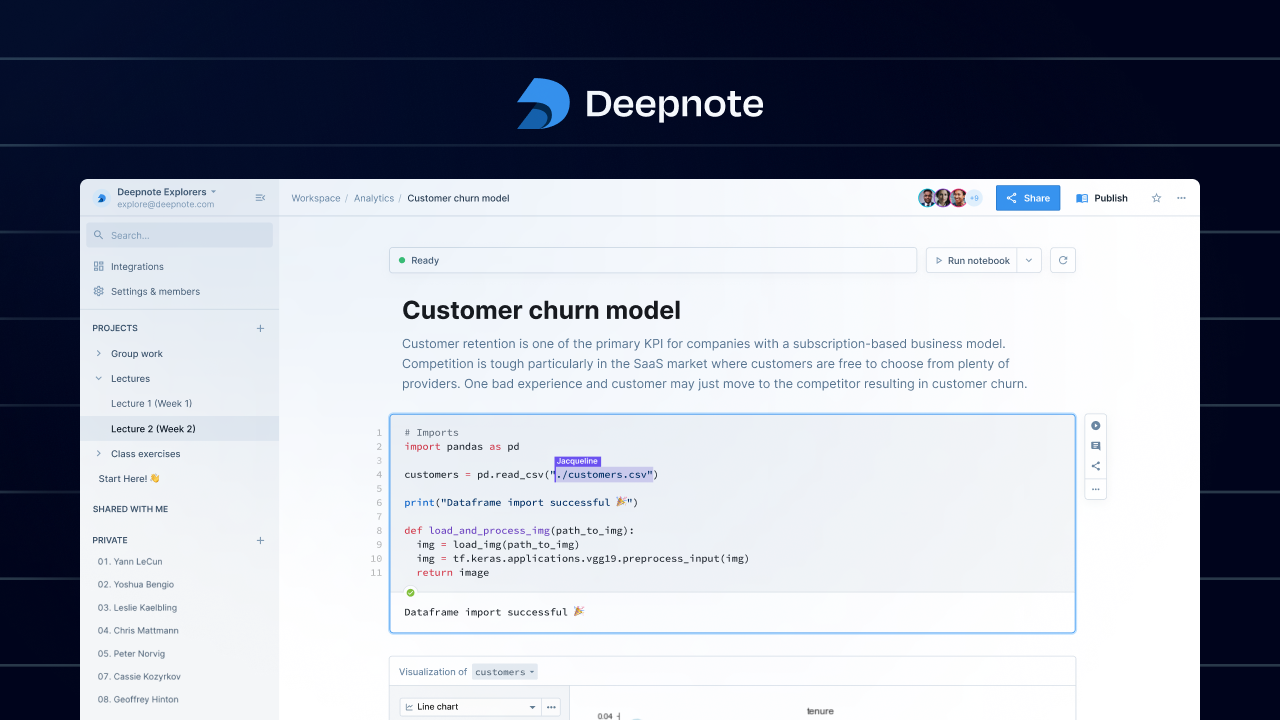
Deepnote is a cloud notebook platform where teams write Python and SQL in the same document with real-time collaboration, commenting and version history, and no local environment setup. Notebooks are executable artifacts: schedulable, API-triggerable and deployable as data apps. It keeps an open notebook format with a …

Best for:Data science teams and ML engineers who need a collaborative, cloud-based notebook environment with GPU access and ETL capabilities, without the overhead of managing local Jupyter setups.Academic researchers, students, and bootcamp graduates who want a free, fully managed Python and SQL environment with easy sharing and version control built in.

Not ideal for: Business users who need a no-code, point-and-click dashboard builder without any exposure to Python or SQL code, as Deepnote's core workflow is notebook-based.

Read more about Deepnote
Rows logo

Rows

AI analyst platform that lets business teams extract, transform, and analyze data from PDFs, APIs, and databases using plain English commands.

Rows was a spreadsheet built for people who wanted live business data rather than static exports. It connected directly to ad platforms, analytics tools, databases and APIs, extracted tables from PDFs and images, and included an AI Analyst that answered plain-language questions about the data in the sheet. Over nine ye…

Best for:Finance and operations teams at startups and scale-ups who need to analyze data from multiple SaaS tools like Stripe, HubSpot, and Google Analytics without relying on an engineering team.Growth analysts and marketing managers who regularly pull data from PDFs, bank exports, or ad platforms and need to summarize it quickly without building a BI dashboard.

Not ideal for: Data analysts or engineers who need a full notebook environment with Python, SQL, or custom ML model integration for complex, multi-step analytical pipelines.

Read more about Rows
Polymer logo

Polymer

No-code AI dashboard and embedded analytics platform that transforms spreadsheets and data sources into interactive, brandable visualizations.

Polymer turns a spreadsheet, Google Sheet, ad platform export or database into an interactive dashboard without setup or modelling, with AI proposing relevant charts and surfacing patterns automatically. Its second product is embedded analytics: a white-label API that lets SaaS companies put branded, self-serve dashboa…

Best for:Marketing agencies and e-commerce managers who need fast, branded client-facing dashboards from ad platforms like Facebook, Google Analytics, and Shopify without spending hours in a BI tool.SaaS founders and product teams who want to embed white-labeled analytics into their own application using a simple API, without building a full analytics layer from scratch.

Not ideal for: Data engineers or analysts who need to run complex SQL queries, write Python, or build multi-step data pipelines, as Polymer is optimized for no-code dashboard creation rather than deep analytical workflows.

Read more about Polymer
Akkio logo

Akkio

AI workflow automation platform for media agencies to build, analyze, and optimize campaigns with predictive models and automated insights.

Akkio is an AI analytics and workflow platform built specifically for media agencies rather than general business intelligence. It connects ad platforms, spreadsheets and warehouses, then uses conversational agents to build audience segments, run no-code predictive models and forecasts for outcomes like ROAS and CPC, s…

Best for:Media agencies managing digital advertising campaigns for multiple clients who need to automate audience analysis, propensity scoring, and performance measurement without hiring in-house data scientists.Data providers and ad tech companies that want to package AI-powered insights and campaign recommendations as a value-added service delivered to their agency partners.

Not ideal for: Individual marketers or small businesses looking for a self-serve analytics tool, as Akkio is priced and architected for agency-scale operations with structured client-campaign workflows.

Read more about Akkio
Obviously AI logo

Obviously AI

No-code predictive analytics tool that lets business analysts build machine learning models and generate forecasts in minutes from spreadsheet data.

Obviously AI is a no-code AutoML platform aimed at business analysts and small teams with no data science function. You upload historical data as a CSV or connect a source, state the question in business terms, such as which customers will churn or how much a region will sell next quarter, and it selects an algorithm, …

Best for:Business analysts and product managers at mid-market companies who need accurate predictions from their historical data but do not have a data science team or the budget to hire one.E-commerce operators, SaaS founders, and marketing teams who want to forecast churn, identify high-value leads, or predict campaign outcomes using their own CRM or transactional data.

Not ideal for: Data scientists and ML engineers who need full control over model architecture, hyperparameter tuning, custom training pipelines, and code-level access to the underlying algorithms.

Read more about Obviously AI
Zoho Analytics logo

Zoho Analytics

GenAI-powered self-service BI platform with 500+ data source integrations, AI assistant Ask Zia, and embedded analytics for SMBs and enterprises.

Zoho Analytics is a self-service BI platform aimed at small and mid-sized teams, and its distinguishing feature in this category is transparency: it publishes real prices where most competitors require a sales call. Plans are per account rather than per seat, running roughly $30, $60, $145 and $575 monthly with a genui…

Best for:Small and mid-market businesses already using Zoho CRM, Zoho Books, or Zoho One who want a BI tool that connects all their Zoho data in minutes without any technical setup.Marketing, finance, and operations teams that need affordable, self-service dashboards with an AI assistant included at no extra cost, without the per-seat expense of Tableau or Power BI.

Not ideal for: Data teams requiring pixel-perfect, publication-quality dashboard aesthetics or deep custom chart customization, as Zoho Analytics has a lower visualization ceiling than Tableau or Power BI.

Read more about Zoho Analytics
DataRobot logo

DataRobot

Enterprise AI platform for building, deploying, and governing predictive and generative AI applications with automated machine learning at scale.

DataRobot is an enterprise AI platform covering the full model lifecycle: automated machine learning that builds and compares many candidate models at once, deployment, monitoring, retraining and governance across both predictive and generative AI. It runs as single-tenant SaaS, in your own VPC or self-managed, integra…

Best for:Enterprise data science teams in financial services, healthcare, and manufacturing who need a governed, scalable AutoML platform to build and deploy accurate predictive models faster than coding from scratch.AI governance and compliance officers who need built-in model monitoring, drift detection, fairness auditing, and regulatory explainability reports bundled into a single enterprise platform.

Not ideal for: Small businesses or individual analysts looking for a lightweight, self-serve BI or dashboard tool, as DataRobot is an enterprise MLOps platform with pricing and complexity scaled to large organizations.

Read more about DataRobot
Qlik Sense logo

Qlik Sense

Enterprise analytics platform powered by a unique associative engine that lets users explore data freely in any direction without predefined query paths.

Qlik Sense is an enterprise analytics platform built on an associative engine, which is its genuine technical differentiator. Where query-based tools return only what matches your filter, Qlik shows both related and unrelated values on every selection, so users can see what is excluded as well as what is included. That…

Best for:Enterprise analytics teams and BI professionals who need to explore complex, multi-source datasets freely without predefined drill paths, and want an associative engine that surfaces hidden relationships other tools miss.Data-driven organizations in finance, retail, and manufacturing that require strong enterprise governance, row-level security, and the ability to embed interactive analytics into their own internal and external applications.

Not ideal for: Small teams or startups on tight budgets, as Qlik Sense is priced for enterprise buyers and the total cost including implementation and data engineering often exceeds $100,000 annually.

Read more about Qlik Sense
Looker logo

Looker

Google Cloud's enterprise BI platform with a powerful semantic layer (LookML), Gemini AI, and governed self-service analytics for data-mature organizations.

Looker is Google Cloud's enterprise BI platform, built around LookML, a semantic modelling layer where business metrics are defined once in code and reused across every dashboard, report and API call. That single-source-of-truth approach is what large organisations buy it for: it prevents the situation where three team…

Best for:Data-mature enterprises already on Google Cloud and BigQuery that need a governed semantic layer defining company metrics once, so every dashboard and report uses the same trusted definitions.SaaS companies building embedded, customer-facing analytics into their product who need a flexible, API-first BI platform that white-labels beautifully and scales to thousands of end users.

Not ideal for: Teams without SQL developers or data engineers who can build and maintain LookML models, as Looker requires significant technical investment before non-technical users can self-serve effectively.

Read more about Looker
Metabase logo

Metabase

Open-source business intelligence platform that makes it easy for anyone to ask questions and learn from data without SQL knowledge.

Metabase is an open-source business intelligence tool built to make data accessible beyond the analytics team. Its visual query builder lets non-technical users filter, group and chart data without writing SQL, while analysts can drop into raw SQL when needed. It also ships an embedding SDK for putting analytics inside…

Best for:Startup and scale-up engineering teams who want a free, self-hosted BI tool that lets the whole company explore data without submitting requests to the data team, cutting analytics lead times from days to minutes.SaaS developers building customer-facing analytics into their application who need an affordable, open-source embedded analytics option with a straightforward SDK and active community support.

Not ideal for: Large enterprises requiring heavy-duty data governance, enterprise SSO, fine-grained role hierarchies, and advanced security controls, as these features are limited in the free open-source tier.

Read more about Metabase
Mode logo

Mode

SQL-first analytics platform combining a collaborative query editor, Python and R notebooks, and interactive dashboards in one workspace for data teams.

Mode is an analytics platform built for analysts who want to write SQL, run Python or R notebooks and publish dashboards without switching tools. Its shared SQL editor keeps every query saved and organised so teams build on each other's work rather than rewriting it, and its notebook layer supports advanced analysis be…

Best for:Data analysts and analytics engineers who want to write SQL and run Python or R notebooks in one place and share polished, interactive reports with business stakeholders without switching between multiple tools.Analytics teams at mid-size SaaS and technology companies that need a centralized platform for both ad-hoc analysis and recurring stakeholder reporting, replacing a fragmented stack of SQL editors, notebooks, and dashboarding tools.

Not ideal for: Non-technical business users who need a no-code, drag-and-drop analytics experience, as Mode's core workflow is SQL-first and assumes familiarity with writing queries.

Read more about Mode
Narrative BI logo

Narrative BI

AI-powered analytics platform that automatically converts marketing and business data into plain-English narratives, insights, and Slack alerts.

Narrative BI inverts the usual BI workflow. Rather than building dashboards and hoping someone checks them, it connects to Google Analytics, Google Ads, Facebook Ads, HubSpot and similar sources, monitors the metrics continuously, and pushes plain-English narratives to Slack or email when something changes. It surfaces…

Best for:Marketing agencies and growth teams who want to automatically surface the most important data changes from multiple platforms and share them with clients or leadership without building dashboards manually.SaaS founders and solopreneurs who need a concise, automated daily digest of their most critical business metrics delivered to Slack, so they can stay informed without opening multiple analytics tools.

Not ideal for: Data analysts and BI professionals who need deep, customizable visual dashboards with full SQL access, complex filters, and pixel-level design control over their charts and reports.

Read more about Narrative BI
Domo logo

Domo

Cloud-native BI platform with 1,000+ data connectors, AI agents, embedded analytics, and low-code app building for enterprise data workflows.

Domo is a cloud-native business intelligence platform that handles the whole stack in one place: data integration from over a thousand connectors, ETL through its Magic ETL builder, dashboarding, self-service reporting, low-code apps, embedded analytics and an AI agent layer. For organisations that want ingestion, tran…

Best for:Enterprise operations, finance, and sales teams that need a single platform to connect hundreds of data sources, build executive dashboards, and deploy AI agents without managing a fragmented multi-tool analytics stack.Retail, healthcare, and financial services organizations that require real-time operational analytics, mobile-friendly dashboards for field teams, and low-code data app building on a unified governed platform.

Not ideal for: Data scientists and ML engineers who need deep Python notebook integration, custom model training infrastructure, or a code-first analytical environment beyond Domo's built-in data science capabilities.

Read more about Domo
Sisense logo

Sisense

AI-powered analytics platform for building, embedding, and composing data experiences into any application with generative AI and a flexible cloud architecture.

Sisense is an analytics platform built primarily for embedding rather than internal dashboards. Its Compose SDK offers a code-first, composable approach so product teams can build data experiences into their own applications rather than iframing someone else's dashboard, and it adds a generative AI assistant, an MCP se…

Best for:SaaS companies and ISVs building analytics-as-a-feature inside their own product who need a flexible, API-first embedded analytics platform that handles multi-tenancy, white-labeling, and AI-generated insights out of the box.Enterprise teams in financial services, healthcare, and supply chain that need a composable, AI-powered analytics platform integrating with their existing application stack via the MCP server and Compose SDK.

Not ideal for: Teams primarily looking for a self-serve BI tool for internal reporting and exploration, as Sisense is optimized for embedded analytics in product rather than standalone internal dashboards.

Read more about Sisense
Sigma Computing logo

Sigma Computing

Cloud-native BI platform with a spreadsheet interface that lets business users explore billions of rows of live warehouse data without writing SQL.

Sigma Computing gives business users a spreadsheet-like interface over live cloud warehouse data. Rather than extracting data into a proprietary engine, queries push down to Snowflake, Databricks, BigQuery or Redshift, so analysis runs against current data at warehouse scale without SQL. For finance and operations team…

Best for:Analytics teams and business users at data-mature companies running Snowflake, BigQuery, or Databricks who are comfortable with spreadsheets but not SQL, and want to self-serve warehouse-scale analysis without depending on a data engineer.Finance, revenue operations, and product teams that need to write back data, model scenarios, and build governed AI applications on live warehouse data in a single, collaborative workspace.

Not ideal for: Organizations that do not have a cloud data warehouse, as Sigma requires Snowflake, BigQuery, Databricks, or Redshift as its data foundation and cannot connect to flat files or local databases as a standalone source.

Read more about Sigma Computing
Anomaly AI logo

Anomaly AI

AI data analyst workspace that turns large Excel, CSV, GA4, Google Ads, Meta Ads, TikTok Ads, BigQuery, Snowflake, and MySQL datasets into traceable dashboards, Excel reports, PowerPoint slides, Word docs, PDFs, and scheduled reports.

Anomaly AI is an analytics workspace for teams that still work in spreadsheets but have outgrown them. It connects to Excel, CSV, Google Sheets, GA4, Google Ads, Meta Ads, TikTok Ads, BigQuery, Snowflake and MySQL, then answers questions in plain language and returns dashboards, Excel exports, slides and scheduled PDF …

Best for:Marketing analysts who need to turn campaign and GA4 data into clear, presentable reports without manual spreadsheet workBusiness operations teams managing large, messy datasets across Excel, BigQuery or MySQL who want reliable, repeatable reportingConsultants who produce recurring client deliverables like dashboards, slides and PDF reports from raw business data

Not ideal for: Teams needing real time streaming or sub minute alerting, since Anomaly AI is built for batch and scheduled analysis rather than live monitoring

Read more about Anomaly AI