Best AI Novel Writer Tools 2026: Story Memory Tested

On this page5 sections
- Quick Comparison at a Glance
- The Best AI Novel Writer Tools — Our Picks
- 1. Sudowrite — Best AI Novel Writer for Story Memory
- 2. NovelAI — Best for Long Series and Deep Lore
- 3. Novelcrafter — Best for Structured Planners
- 4. ChatGPT and Claude — Best Free Way to Start
- How to Choose the Right AI Novel Writer
- Frequently Asked Questions
- Final Verdict
The right AI novel writer isn't the one that writes the smoothest sentence — it's the one that still remembers your protagonist's motivation by chapter 15.
- Winner: Sudowrite — Story Bible tracks characters and plot across chapters, purpose-built for fiction
- Best free option: ChatGPT — fine for brainstorming and short scenes, not full manuscripts
- Best for deep lore/long series: NovelAI — Lorebook system built for sprawling worldbuilding
- Best for structured planners: Novelcrafter — persistent story bible plus bring-your-own AI model
- The failure mode that ends most AI-assisted novels isn't writing quality — it's the model forgetting who a character is or what already happened by chapter 10
- General chatbots like ChatGPT and Claude work inside a fixed context window; once a manuscript outgrows it, earlier chapters fall out of active memory unless you manually re-paste them
- Purpose-built AI novel writers solve this with a persistent story bible — a database of characters, plot threads, and lore the AI references on every generation, not a chat history it has to hold in its head
- Free general chatbots are genuinely fine up to roughly 20,000-30,000 words; past that, the manual context-management tax usually outweighs a $10-20/month subscription
- No AI tool here reliably writes a complete, voice-consistent novel unsupervised — every one is built as a collaborator, not an autopilot
Ask around in any writers' forum about using AI on a novel and you'll hear the same complaint eventually: it's not that the prose is bad, it's that somewhere around chapter 10 a character's eye color changes, a dead sibling shows back up, or the AI just quietly forgets a plot thread it set up 20,000 words earlier.
That's not a prompting problem. It's a memory architecture problem. General chatbots hold your conversation in a fixed context window — once your manuscript outgrows it, earlier chapters stop being visible to the model unless you paste them back in.
Purpose-built AI novel writers solve this differently, with a persistent story bible the AI checks on every generation instead of a chat log it has to remember. That distinction is what this comparison is actually about — for the wider picture of how these tools fit alongside traditional software at every stage, and for more on general-purpose options for AI writing tools beyond fiction, see our full breakdown of novel writing software by stage.
Quick Comparison at a Glance
| Tool | Best For | Free Plan | Price (USD/mo) | Rating |
|---|---|---|---|---|
| Sudowrite | Story memory + active co-writing | No | $10-$59 | 4.6/5 |
| NovelAI | Long series, deep lore | No (free trial) | $10-$25 | 4.3/5 |
| Novelcrafter | Structured planning + BYO model | No (free trial) | $4-$20 + AI cost | 4.2/5 |
| ChatGPT | Brainstorming, short scenes | Yes | Free–$20 | 4.4/5 |
| Claude | Brainstorming, longer single sessions | Yes | Free–$20 | 4.4/5 |
Ratings reflect general fiction-writing use, not each tool's full product. The breakdowns below go deeper on how each one actually handles consistency.
The Best AI Novel Writer Tools — Our Picks
1. Sudowrite — Best AI Novel Writer for Story Memory
Sudowrite is the most established AI tool built specifically for fiction, and its Story Bible is the reason it wins this comparison.
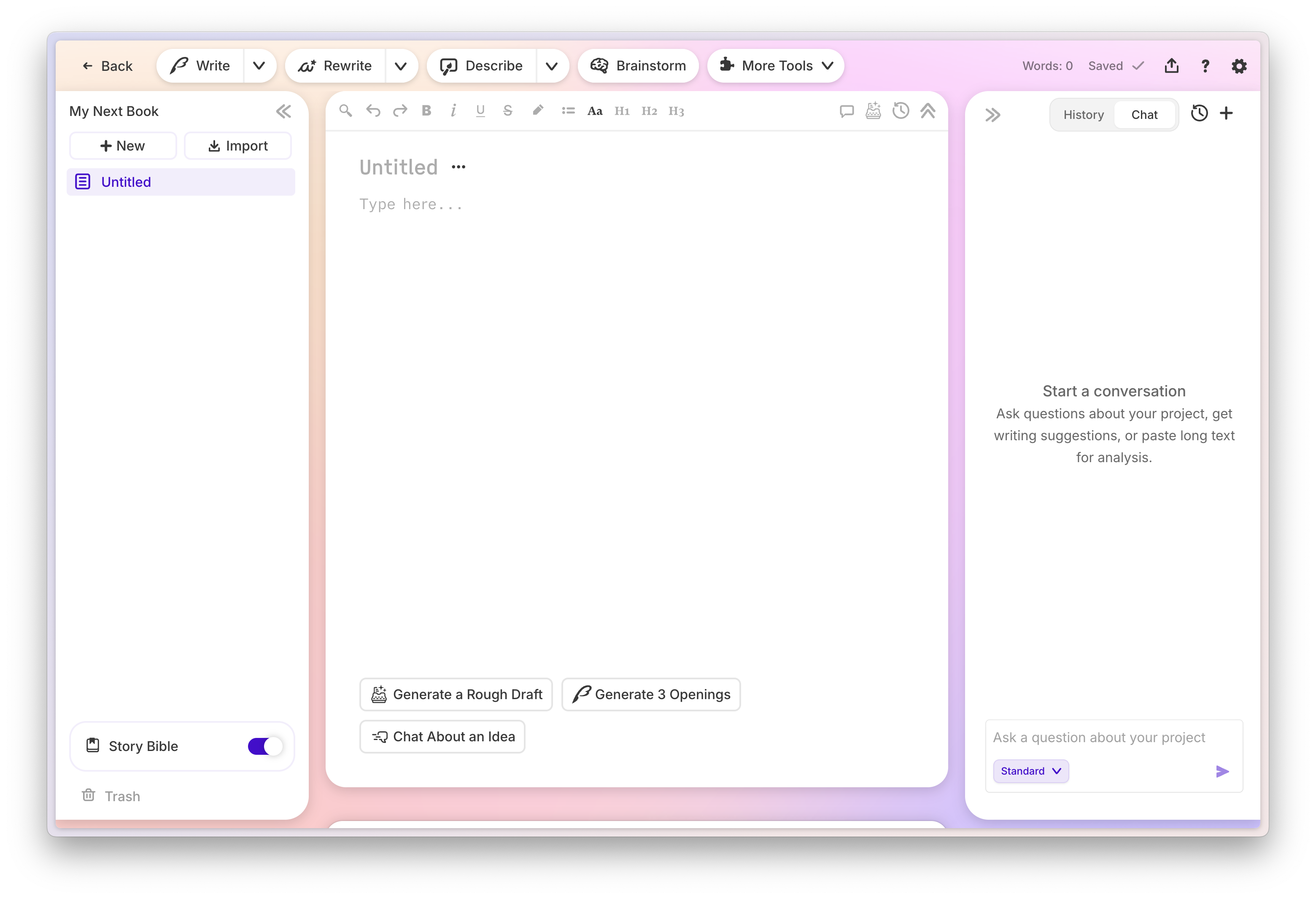
Instead of relying on chat history, Sudowrite stores your characters, settings, and plot threads as structured entries that the AI actively references every time it generates new text — so a scene written in chapter 20 still knows what your protagonist learned in chapter 3. Per Sudowrite's own Story Bible documentation, it works as a "source of truth" both writer and AI reference back to — a fundamentally different mechanism from a chatbot trying to hold your story inside one long conversation.
Key features:
- Story Bible for character and plot consistency
- Canvas for visual scene planning
- Targeted tools: Describe, Brainstorm, Rewrite, Expand
- Chapter-length generation with your established voice as context
Pricing: $10-$59/month depending on plan Best for: writers who want an active AI collaborator with consistency tracking built in, not bolted on Not ideal for: writers who want zero AI involvement in their actual prose
2. NovelAI — Best for Long Series and Deep Lore
NovelAI runs fiction-tuned language models alongside a Lorebook system, and it's the strongest option here if you're managing a multi-book series rather than a single standalone novel.

The Lorebook goes further than Sudowrite's Story Bible for sprawling casts — you can track relationships, factions, and world rules that carry across multiple books, and independent comparisons consistently note the output reads more literary than general-purpose AI text.
Key features:
- Fiction-tuned language models
- Lorebook for deep worldbuilding and lore consistency
- Fine-grained control over generation length and style
- Multi-modal tools including visual generation
Pricing: $10-$25/month Best for: writers leaning on AI more heavily who need consistent lore across a long series Not ideal for: a single standalone novel — the setup overhead outweighs the benefit for a one-book project
3. Novelcrafter — Best for Structured Planners
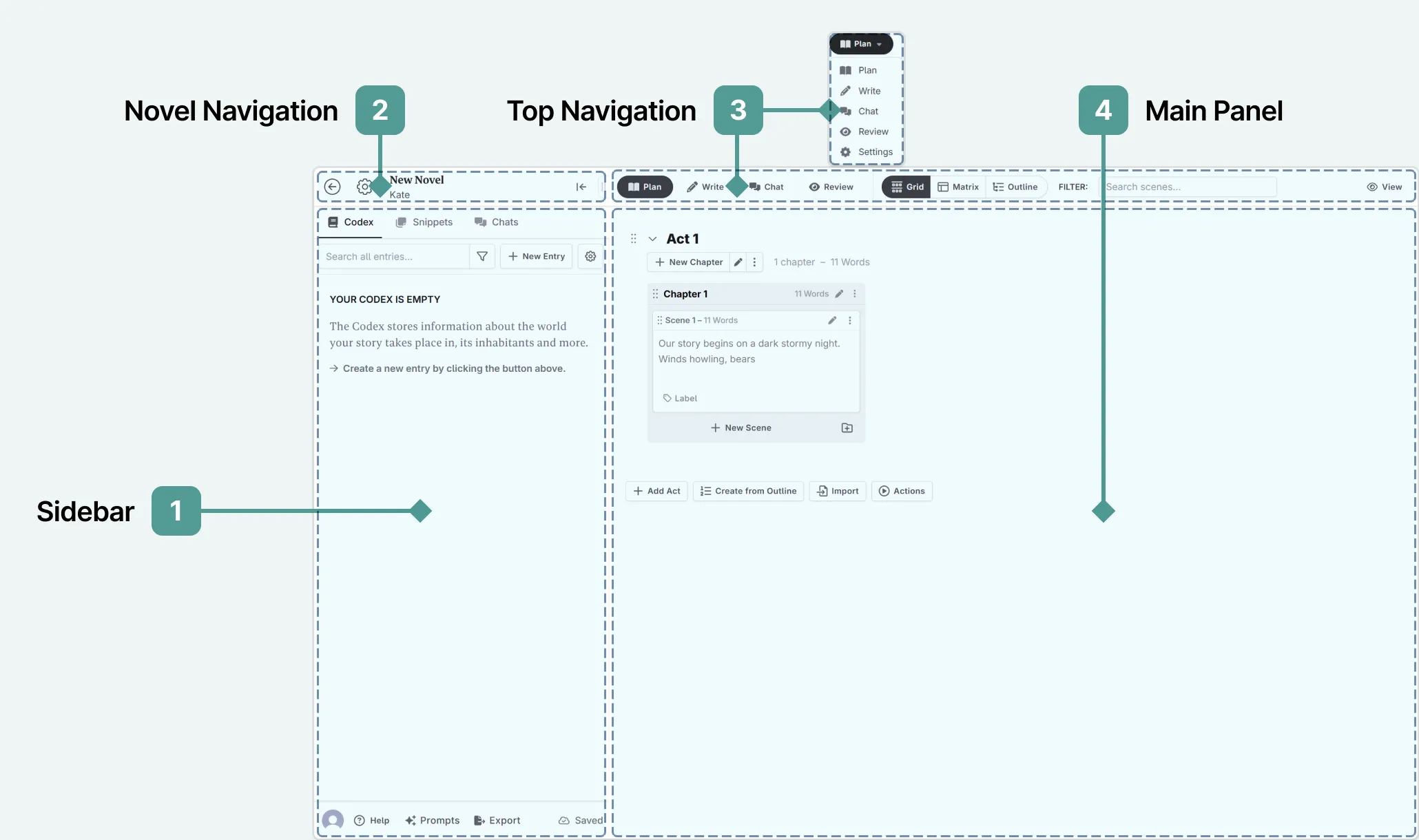
Novelcrafter is built around a persistent story bible too, but the real difference is in the planning layer — Board, Grid, Matrix, and Outline views let you map an entire plot and cast before you generate a single scene, and you bring your own AI model (OpenAI, Claude, or others) rather than being locked to one.
Writers who already think in outlines and spreadsheets get the most out of this one. Everyone else tends to find the learning curve steeper than it needs to be.
Key features:
- Persistent story bible referenced across all AI generations
- Multiple planning views (board, grid, matrix, outline)
- Bring-your-own AI model
- Scene-level drafting tied back to your outline
Pricing: $4-$20/month plus your own AI provider's usage bill Best for: highly organized writers already comfortable with structured planning tools Not ideal for: writers who want to open a blank page and start drafting immediately
4. ChatGPT and Claude — Best Free Way to Start
ChatGPT and Claude are what most people actually try first, and honestly, that's fine — up to a point. Both are genuinely strong at brainstorming plot ideas, punching up dialogue, and drafting a scene or two. Claude's context window has grown large enough on paid plans to hold a full session together noticeably better than ChatGPT — Anthropic's own documentation puts it at up to 1 million tokens on its newer models — but that's still a session limit, not persistent story memory.

The limitation shows up the same way in both: once your manuscript exceeds what fits in the active context, earlier chapters stop being visible to the model. You either re-paste character notes and prior chapters every session, or the AI starts contradicting itself — the exact problem this whole comparison is about.
Key features:
- Free tier available on both
- Strong at brainstorming and dialogue
- No manuscript-length story memory
- Requires manual context re-establishment past a certain length
Pricing: free tier; paid plans from roughly $20/month Best for: short stories, brainstorming, and drafts under about 20,000-30,000 words Not ideal for: full-length manuscripts without a separate system for tracking consistency
How to Choose the Right AI Novel Writer
If you're under 20,000 words and just testing whether AI-assisted fiction suits you, stick with ChatGPT or Claude's free tier — there's no reason to pay yet. Once you're past that and feel yourself re-explaining your own plot to the AI every session, that's the signal to move to a purpose-built tool. Pick Sudowrite if you want an active co-writer for the actual drafting, NovelAI if you're managing a long series with heavy worldbuilding, and Novelcrafter if you're the type who plans obsessively before writing a word.
If drafting prose is only part of what you need — outlining, research, or a formatting step down the line — the full book writing toolkit covers those other stages too.
Frequently Asked Questions
Can ChatGPT remember earlier chapters when writing a novel? Not reliably. ChatGPT and Claude work within a fixed context window, so once a conversation or document exceeds it, earlier chapter details fall out of active memory unless you manually re-paste them.
Which AI is best for writing a full novel? Sudowrite and NovelAI are the two purpose-built options with persistent story memory. ChatGPT and Claude work for brainstorming and short scenes but need constant manual context management for anything book-length.
Is it worth paying for a dedicated AI novel writer instead of just using ChatGPT? Yes, once you're past roughly 20,000-30,000 words. Below that, ChatGPT's free tier is enough. Past it, the manual work of re-establishing context every session outweighs a $10-20/month subscription.
Can AI write an entire novel by itself? Not reliably in 2026. Every AI-native fiction tool here is built and marketed as a collaborator with story-memory tooling, not an autonomous novel generator — unsupervised long-form output still drifts in tone and contradicts itself over enough pages.
Final Verdict
If you're starting a novel and want AI help that actually remembers what you told it, Sudowrite is the one I'd point most people to first — the Story Bible does the specific job a chatbot can't. If you're already deep into a multi-book series with a large cast, NovelAI's Lorebook is worth the extra setup. And if you're still under 20,000-30,000 words, don't pay for anything yet — ChatGPT or Claude will carry you that far for free, and you'll know exactly when you've outgrown them because you'll be the one doing the remembering instead of the AI.
Whichever tool you draft with, don't skip the revision pass — AI-generated prose usually needs a heavier edit than it looks like it needs. Our breakdown of book editing software covers what ProWritingAid, Grammarly, and AutoCrit each actually catch.