Midjourney Alternatives: The Best Tool for Every Reason You're Switching

On this page5 sections
- Quick Comparison at a Glance
- The Best Midjourney Alternatives by Why You're Actually Switching
- If You're Switching Because of Cost
- If You Refuse to Use Discord
- If You Need a Real Commercial License
- If You Need API Access or Want to Self-Host
- How to Choose the Right Midjourney Alternative
- Frequently Asked Questions
- Final Verdict
There's no single "best" Midjourney alternative — it depends on why you're actually leaving. Leonardo AI wins if cost is the problem and you want Midjourney's stylized look for free. Stable Diffusion wins if you want zero ongoing cost, forever, by self-hosting. Adobe Firefly wins if you need a real, verified commercial license. Freepik AI Suite wins if you want API access without managing your own infrastructure.
- There's no universal "best Midjourney alternative" — the right pick depends on whether you're leaving over cost, the Discord-first workflow, unclear commercial rights, or a need for API/self-hosted access
- Midjourney itself now has a web app, so "no Discord" alone isn't much of a reason to switch anymore — cost, licensing, and API access are the stronger reasons
- Adobe Firefly's free tier does not include commercial use rights — only the paid Firefly Premium plan ($4.99/mo) does, a detail most competitor roundups skip entirely
- Self-hosted Stable Diffusion is the only option here that's free with no ongoing usage cap, under a Community License that stays free for businesses earning under $1M a year
- Free-tier limits change fast and vary a lot: Leonardo AI gives 150 tokens a day, ChatGPT's free tier caps out at 2-3 images per rolling 24 hours — know the real number before you commit to a tool
Searching for a midjourney free alternative isn't really one question. Someone priced out of a $10-a-month subscription has a completely different problem than someone who needs a verified commercial license before they can sell what they generate, or a developer who wants an API instead of a chat window. So instead of another flat top-10 list, this one's organized by the actual reason you're switching: cost, ditching the Discord-first workflow, needing real commercial rights, or wanting API access and self-hosting.
You'll find two vetted picks in each category below, real free-tier numbers instead of vague "generous" claims, and honest limitations for each. If you're specifically hunting for a sprite generator for game assets, ChatGPT's native image generation, the fastest model available, or a fully free API, this pillar routes to deeper posts on each of those once they're live. You can also browse the full list of AI image generation tools on YourAiFinder if none of these eight quite fit what you need.
Most "Midjourney alternative" roundups you'll find elsewhere aren't neutral. Several of the top-ranking articles for this exact search are published by the company selling the tool they recommend first — a ZSky AI blog post ranks ZSky AI, a Nano Banana blog post ranks Nano Banana. Nobody impartial has actually organized this space by what you're trying to solve. That's the gap this article fills.
Quick Comparison at a Glance
| Tool | Best For | Free Plan | Starting Price |
|---|---|---|---|
| Leonardo AI | Closest free style match to Midjourney | Yes, 150 tokens/day | $12/mo |
| Nano Banana | Fully free stylized generation via Gemini | Yes | Free |
| Canva | Fastest route to a finished asset | Yes, generous | $15/mo Pro |
| Craiyon | No account needed at all | Yes, unlimited (ad-supported) | Free |
| Adobe Firefly | Real commercial license (paid tier) | Yes, 25 credits/mo, no commercial use | $4.99/mo Premium |
| ChatGPT | Already-paying-for-it convenience | Yes, 2-3 images/24hr | $20/mo Plus |
| Stable Diffusion | Self-hosting, zero ongoing cost | Yes, hosted demo | Free (self-hosted) |
| Freepik AI Suite | Hosted API, no infrastructure | Yes, limited | Paid credit packs |
Pricing and free-tier limits shift often — treat the numbers above as a starting point and confirm on the tool's own pricing page before committing. If cost is the reason you're here, skip straight to the next section.
The Best Midjourney Alternatives by Why You're Actually Switching
Midjourney is still the benchmark for stylized, art-directed output with minimal prompting effort. But it's subscription-only with no free tier, it doesn't self-host, and its commercial terms depend on which plan you're paying for. Every tool below solves one specific reason people leave. Read the "Best for" and "Not ideal for" lines honestly — that's the part most roundups skip.
If You're Switching Because of Cost
1. Leonardo AI — Best Free Match for Midjourney's Look
Leonardo AI is the closest most people get to Midjourney's stylized, painterly output without paying a subscription just to try it.

Its Phoenix models are the reason it keeps showing up as the top free pick in side-by-side comparisons — the aesthetic leans the same direction as Midjourney's, and the free tier isn't a stripped-down demo. You get 150 tokens every 24 hours, which is enough to genuinely test a project idea before deciding whether to pay. The catch most reviews leave out: those tokens don't roll over, and free-tier generations are public — other Leonardo users can see and remix them, and you don't hold exclusive IP on what you make for free.
- Phoenix image models tuned for stylized, art-directed output
- 150 free tokens every 24 hours
- Trained "Elements" for consistent custom style
- Fully browser-based — no Discord, no app install
- API access available on paid tiers
Pricing: Free (150 daily tokens) | Essential $12/mo (8,500 monthly tokens) | Premium $30/mo | Ultimate $60/mo.
Best for: readers who want Midjourney's art-directed look without paying a subscription just to try it out. Not ideal for: anyone who needs their free-tier work to stay private — it doesn't, and Leonardo holds the IP on it.
For the full breakdown of exactly how far 150 daily tokens actually gets you, see our deep dive on Leonardo AI's 150-token free plan.
2. Nano Banana — Best Fully Free Option
Nano Banana is Google's Gemini-native image generation model, and it's the option on this list with no paid tier gate at all standing between you and better output.
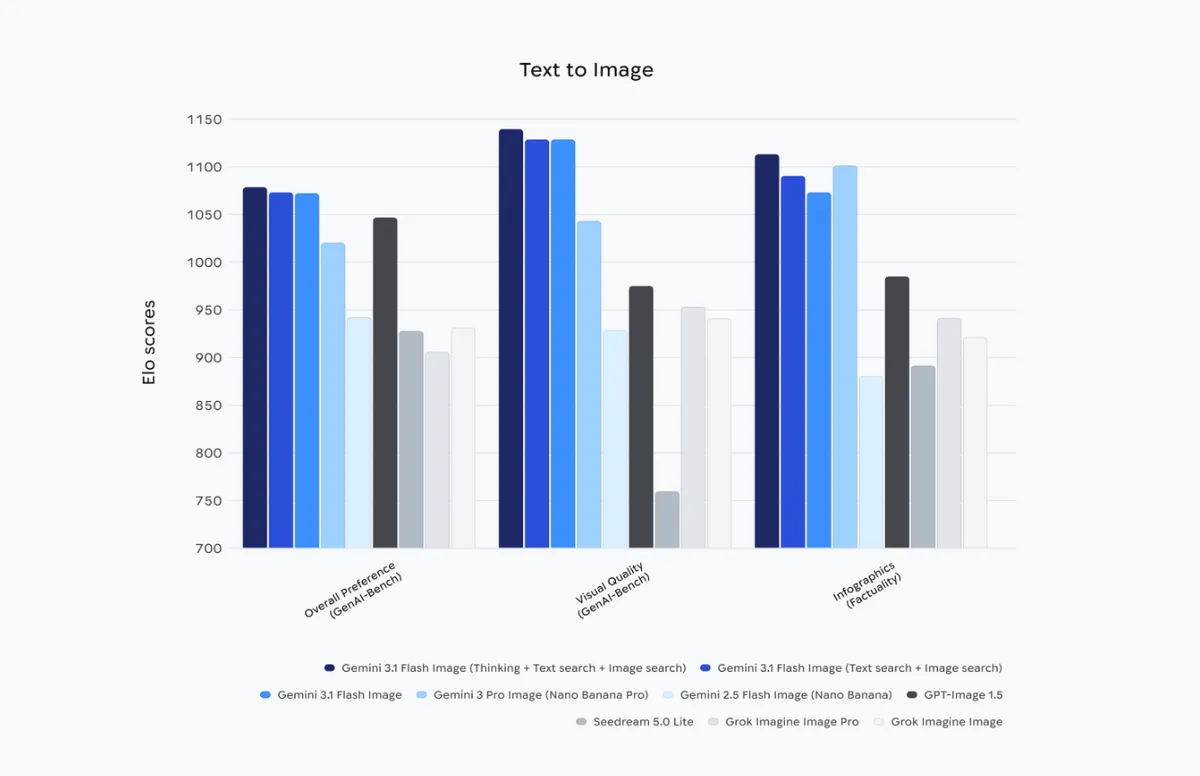
There's no token math to track and no daily allowance to run out of — it's free, full stop, which is rare in this space. 2026 comparison roundups keep citing it as one of the closest rivals to Midjourney's style among genuinely free tools, and it updates often as Google iterates on the underlying Gemini model. What you give up is depth of control: there's no equivalent to Leonardo's trained Elements or Midjourney's parameter system for fine-tuning a specific look across a series.
- Gemini-native image generation
- No Discord, no separate app install
- Fully browser-based
- Fast generation turnaround
- Frequent model updates from Google
Pricing: Free.
Best for: readers who want zero cost with no daily-token math to track. Not ideal for: anyone who needs fine-grained style controls or a trained custom model — Nano Banana's strength is speed and accessibility, not deep customization.
If You Refuse to Use Discord
3. Canva — Best for a Finished, On-Brand Asset Fast
Canva builds AI image generation straight into the same editor you'd use to drop that image into a finished post, deck, or ad — no separate app to learn just to get one image.
That's the real advantage over a standalone generator: you're not exporting an image and importing it somewhere else. Type a prompt, generate, and the result lands directly on a canvas next to your brand kit, fonts, and templates. It won't chase Midjourney's specific painterly art style — Canva's generator is built for practical, on-brand assets, not fine art — but for marketers and solopreneurs who need the image finished and shipped, that's rarely the point anyway.
- AI image generation built into the main editor
- Drag-and-drop layout tools
- Massive template library
- Brand kit for consistent colors and fonts
- One-click resizing across social formats
Pricing: Free (generous) | Pro $15/mo.
Best for: marketers and solopreneurs who need the image dropped straight into a finished post or deck. Not ideal for: readers chasing Midjourney's specific stylized art look — Canva optimizes for finished assets, not fine art.
4. Craiyon — Best for Zero Signup Friction
Craiyon skips the account entirely. Open the site, type a prompt, get images back. No email, no verification step, nothing to remember a password for.
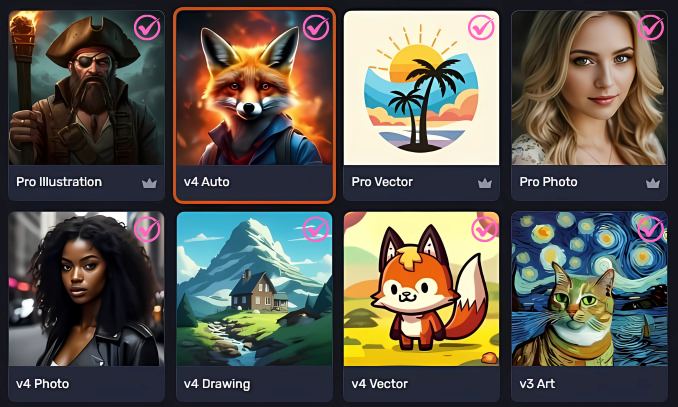
That makes it the fastest possible way to test whether an idea is even worth pursuing further before committing to a tool with an account and a learning curve. The tradeoff is obvious the moment you compare output quality side by side with Leonardo or Nano Banana — Craiyon trades polish for pure accessibility, and it shows in fine detail and prompt adherence. It's ad-supported rather than metered, so there's no daily cap to hit, just ads to sit through.
- No signup or account required
- Ad-supported free generation with no usage cap
- Simple, single prompt box
- Fast turnaround per generation
- Instant downloadable results
Pricing: Free (ad-supported, unlimited use).
Best for: someone who wants to test a prompt idea right now without creating another account. Not ideal for: readers who need Midjourney-level output quality — Craiyon trades polish for zero friction.
If You Need a Real Commercial License
5. Adobe Firefly — Best for Verified Commercial Rights
Adobe Firefly is trained only on licensed Adobe Stock content and public domain material, which is exactly why it's the tool most often cited as commercially safe to use — but only on the paid tier.
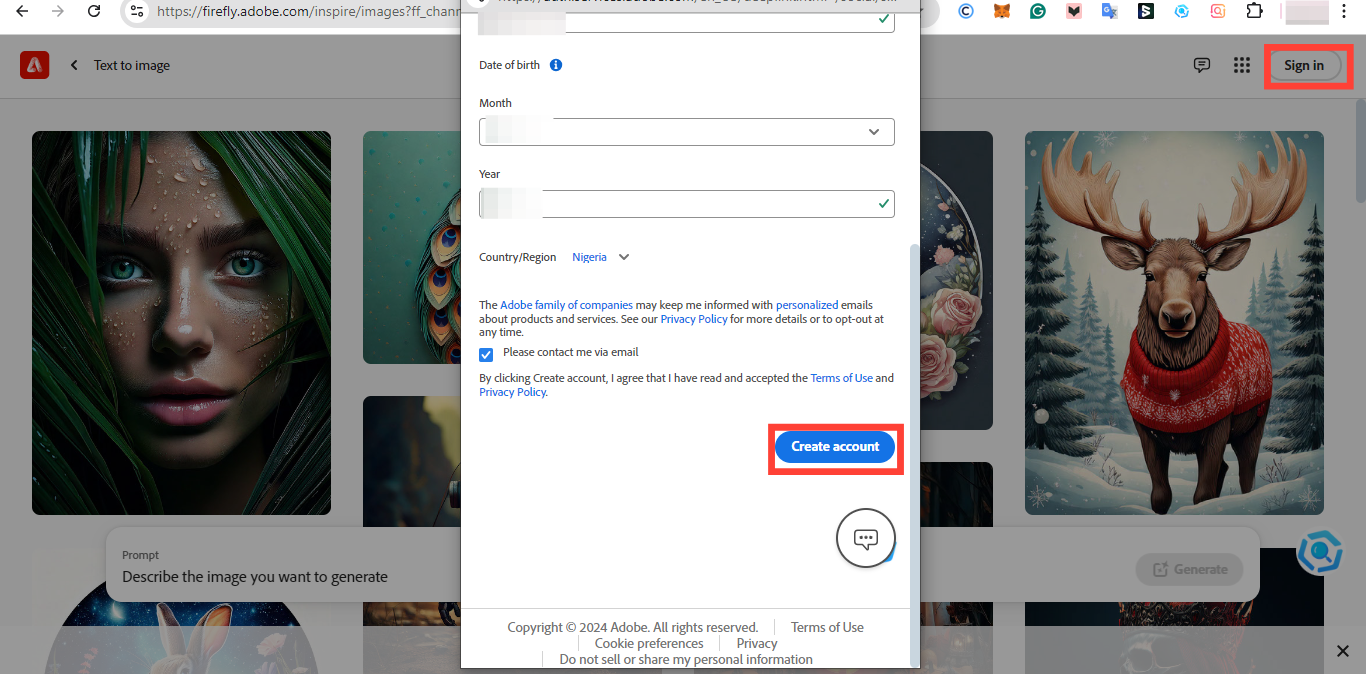
This is the detail most competitor roundups get wrong or skip entirely: per Adobe's own generative credits FAQ, Firefly's free plan gives you 25 generative credits a month, but it does not include a commercial use license, and free-tier output carries a watermark. You need Firefly Premium at $4.99/mo — which bumps you to 100 monthly credits and removes both the watermark and the licensing gap — before you can actually sell or publish what you generate. If your work is going anywhere near a paying client, this is the one to budget for.
See our full breakdown of Adobe Firefly's free plan limits for the complete picture.
- Trained exclusively on commercially licensed data
- Native integration with Photoshop and Illustrator
- Generative Fill for in-context editing
- Curated style presets
- Watermark-free output on paid plans
Pricing: Free (25 credits/mo, watermarked, no commercial license) | Firefly Premium $4.99/mo (100 credits, commercial license included).
Best for: freelancers and businesses who need to actually sell or publish work made with generated images. Not ideal for: readers assuming the free tier already covers commercial use — it doesn't, and using free-tier output commercially is a real licensing risk.
6. ChatGPT (GPT Image 2) — Best If You Already Pay for It
If you're already a ChatGPT Plus subscriber, image generation through GPT Image 2 is bundled in at no extra cost — no second subscription, no separate account.
What sets it apart isn't raw aesthetic quality so much as instruction-following: GPT Image 2's reasoning-aware prompting handles detailed, multi-part instructions ("add text that says X in the top-left, make the background blue, keep the dog on the right") more reliably than most dedicated image generators, and you can iterate on the result in the same chat thread. The free tier is the tightest limit on this entire list — 2-3 images per rolling 24-hour window — which makes it a genuinely poor fit if you're generating in volume without a paid plan.
- GPT Image 2 generation model
- Bundled into an existing ChatGPT subscription
- Strong instruction-following on detailed prompts
- In-chat iteration and refinement
- No separate account needed for existing Plus users
Pricing: Free (2-3 images per rolling 24-hour window) | Plus $20/mo (bundled with the full ChatGPT subscription).
Best for: readers who already pay for ChatGPT Plus and don't want a second subscription just for images. Not ideal for: high-volume free users — the 2-3 image daily cap is the tightest free-tier limit of any tool in this roundup.
If You Need API Access or Want to Self-Host
7. Stable Diffusion — Best for Self-Hosting and Zero Ongoing Cost
Stable Diffusion is the only tool on this list you can run entirely on your own hardware — no subscription, no usage cap beyond what your GPU can handle.
Under the Stability AI Community License, SD3.5 and SDXL stay free for commercial use as long as your organization earns under $1M in annual revenue; older models like SD 1.5 and the original SDXL use the more permissive CreativeML Open RAIL-M license with no revenue cap at all. If you'd rather not manage your own infrastructure, there's also a hosted web demo for quick testing and the Stability AI API for credit-based, pay-as-you-go generation — though the API itself has no ongoing free tier beyond a small one-time signup credit grant (roughly 25 credits, enough for about 8 Core-tier generations). Self-hosting removes the per-image charge entirely; at real volume, that's the cheapest option here by a wide margin, and it keeps your prompts and outputs off someone else's servers.
For a direct comparison against the other free-tier favorite on this list, see our head-to-head on Stable Diffusion vs Leonardo AI's free tiers.
- Fully self-hostable, open-weight models (SD3.5, SDXL, and older versions)
- Community License stays free for commercial use under $1M revenue
- Hosted web demo for quick testing without setup
- Stability AI API for credit-based hosted access
- No per-image fee once self-hosted — GPU compute is the only ongoing cost
Pricing: Free (self-hosted, GPU compute only) | hosted web demo free (limited) | Stability API is credit-based with no ongoing free tier beyond a small signup grant.
Best for: developers and studios who want to eliminate per-image costs at volume, or who need generation without sending data to a third party. Not ideal for: readers without a capable GPU or the patience to set up a local environment — this is the least plug-and-play tool on this list.
8. Freepik AI Suite — Best Hosted API With No Infrastructure
Freepik AI Suite gives you API-based generation without asking you to manage a GPU or a self-hosted server at all.
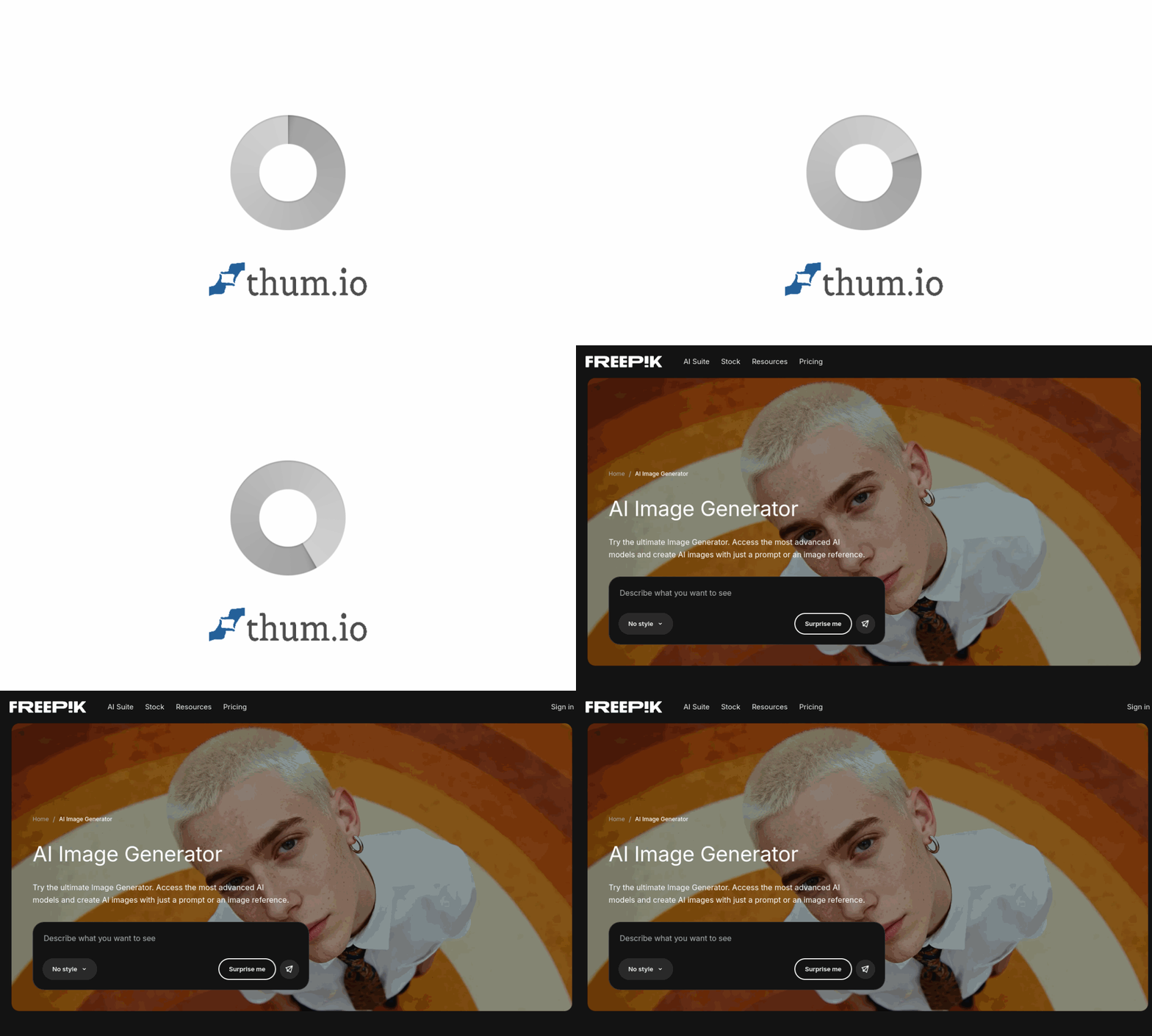
The practical advantage over Stable Diffusion's API is what it's bundled with: Freepik's own stock-asset library sits right alongside the generation API, which matters for projects that mix AI-generated images with licensed stock photography in the same workflow. It scales on credit packs rather than a flat subscription, so cost tracks usage — a real advantage for low-volume projects, a real disadvantage the moment volume climbs high enough that self-hosting would have been cheaper.
- Hosted API access with no self-hosting setup
- Integrated stock-asset library alongside generation
- Multiple underlying generation models
- Credit-based scaling for production use
- No GPU or infrastructure management required
Pricing: Free (limited) | paid credit packs for API and production use.
Best for: developers who want an image-generation API without managing infrastructure themselves. Not ideal for: high-volume production use, where self-hosted Stable Diffusion works out cheaper per image over time.
How to Choose the Right Midjourney Alternative
Match the tool to the actual reason you're leaving, not the longest feature list:
- Price is the blocker → Leonardo AI or Nano Banana
- You're done with the Discord-first workflow → Canva or Craiyon
- You need clear commercial rights → Adobe Firefly Premium
- You need API access or want to self-host → Stable Diffusion or Freepik AI Suite
One honest caveat: Midjourney's own web app already removed the Discord requirement as of 2026, so if that's your only complaint, it may no longer be a real reason to switch. The stronger reasons to actually leave are cost, licensing clarity, and API or self-hosting needs — pick the tool that solves the specific one that applies to you.
Still not sure which category actually applies to you? Our interactive AI image generator advisor asks a few quick questions about what you're making and gives you one direct pick instead of another list to self-select from.
Frequently Asked Questions
What is the best completely free Midjourney alternative? It depends on the reason for switching: Leonardo AI is the closest aesthetic match on a no-cost daily allowance of 150 tokens, while self-hosted Stable Diffusion is the only option that's free with no ongoing cap at all if you have the hardware to run it.
Can I use an AI art generator like Midjourney without Discord in 2026? Yes. Midjourney itself now has a web app, but the well-known Discord-free alternatives are Leonardo AI, Adobe Firefly, Canva, and Google's Nano Banana — all fully browser-based with no chat-command workflow.
Which Midjourney alternative is actually free for commercial use? Self-hosted Stable Diffusion under the Community License is free for commercial use for organizations under $1M in annual revenue. Among hosted tools, Adobe Firefly requires the paid Firefly Premium plan ($4.99/mo) for a commercial license — the free Firefly tier does not include one.
Is there a Midjourney alternative with an API? Stability AI's API for Stable Diffusion models is the most commonly used, though it has no ongoing free tier beyond a small one-time signup credit. Leonardo AI and Freepik AI Suite also expose paid API access for developers who'd rather not self-host.
What's the closest free alternative to Midjourney's art style? Leonardo AI's Phoenix models and Google's Nano Banana are the two most frequently cited as closest to Midjourney's stylized, painterly output among genuinely free options.
Final Verdict
If you just want Midjourney's look without paying a subscription to test it, start with Leonardo AI — 150 free daily tokens is enough to know if it fits before you spend anything. If cost at volume or data privacy matters more than convenience, self-host Stable Diffusion and never think about per-image pricing again. And if what you generate is going to be sold or published commercially, don't skip the licensing question — Adobe Firefly Premium is the one built to answer it cleanly.
There's no universal replacement for Midjourney here — just the right one for the specific reason you're actually leaving.